![[Top]](../images/home.jpg)

![[Contents]](../images/contents.jpg)
![[Next]](../images/next.jpg)
![[Last]](../images/index.jpg)
![[Search]](../images/search.jpg)

Numeric A B C D E F G H I J K L M N O P Q R S T U V W X Y Z
A hub providing a common termination point for hosts connected to 10Base-T wiring. See also 10Base-T.
A MAX TNT card containing four 10Base-T Ethernet interfaces. The card provides full 10-Mbps access to up to four Ethernet networks. See also 10Base-T.
A MAX TNT card containing four 10Base-T Ethernet interfaces and one 100Base-T Ethernet interface. The card provides full 10-Mbps access to up to four Ethernet networks, and 100-Mbps access to a single Ethernet network. See also 10Base-T, 100Base-T.
The 802.3 IEEE standard for operating a 100-Mbps Ethernet network. It differs from the 10Base-T standard by requiring higher-grade cable or more wiring pairs, and by supporting cable lengths that are only a tenth as long as 10Base-T cable lengths. See also 10Base-T.
An IEEE protocol specification for the Media Access Control (MAC) header of an IPX frame in NetWare 3.12 or later. An 802.2 frame contains the Logical Link Control (LLC) header in addition to the MAC header. Compare with 802.3, Ethernet II, SNAP. See also IPX frame, LLC, MAC.
An IEEE protocol specification for the Media Access Control (MAC) header of an IPX frame in NetWare 3.11 or earlier. An 802.3 frame does not contain the Logical Link Control (LLC) header in addition to the MAC header. The 802.3 frame is also called Raw 802.3. Compare with 802.2, Ethernet II, SNAP. See also IPX frame, LLC, MAC.
An IEEE protocol specification for the physical layer and Media Access Control (MAC) sublayer of a token-ring topology. 802.5 implements token passing over Shielded Twisted Pair (STP) cabling, and offers data rates of 4 or 16 Mbps. See also STP cable.
Area Border Router. An ABR is an Open Shortest Path First (OSPF) router that belongs to both a regular area and the backbone area. See also area, backbone area, OSPF.
A packet sent by the RADIUS server to inform the MAX TNT that a client's request for access has been granted. See also RADIUS server.
A request for the user to enter a password in a hand-held token card. The token-card server sends the Access-Challenge packet through the RADIUS server and the MAX TNT to the user. See also RADIUS server, token card, token-card server.
A response from the RADIUS server informing the MAX TNT that it has accepted a new password. See also RADIUS server.
A response from the RADIUS server informing the MAX TNT that it has rejected a new password. See also RADIUS server.
A password-change request that the MAX TNT sends to the RADIUS server. See also RADIUS server.
A packet the RADIUS server sends to inform the MAX TNT that it has not granted a client's request for access. The RADIUS server sends an Access-Reject packet if the user enters an unknown user name, fails to enter the correct password, or enters an expired password. See also RADIUS server.
A packet that the MAX TNT sends to the RADIUS server on behalf of a client attempting to establish a connection. See also RADIUS server.
A way to log information in RADIUS about Start session, Stop session, and Failure-to-start session events. When the MAX TNT recognizes one of these events, it sends an accounting request to RADIUS. When the accounting server receives the request, it combines the information into a record and timestamps it. Each type of accounting record contains attributes associated with an event type, and can show the number of packets the MAX TNT transmitted and received, the protocol in use, the user name and IP address of the client, and other session information. See also accounting server, Failure-to-start session, proxy RADIUS accounting, Start session, Stop session.
See AFS record.
A request for accounting information. The MAX TNT sends an Accounting-Request packet to the RADIUS accounting server. See also accounting server, RADIUS.
A packet containing accounting information. The RADIUS accounting server sends an Accounting-Response packet to the MAX TNT. See also accounting server, RADIUS.
The RADIUS daemon with accounting enabled. See also accounting, RADIUS daemon.
A form of token-card authentication in which RADIUS forwards a connection request to a Security Dynamics ACE/Server. The ACE/Server sends an Access-Challenge packet back through the RADIUS server and the MAX TNT to the user dialing in. The user sees the challenge message, obtains the current token from his or her card, and enters the token. (A token is a type of password.)
The token travels back through the MAX TNT and the RADIUS server to the ACE/Server. The ACE/Server sends a response to the RADIUS server, specifying whether the user has entered the proper user name and token. If the user enters an incorrect token, the ACE/Server returns another challenge, and the user can again attempt to enter the correct token. The server sends up to three challenges. After three incorrect tries, the MAX TNT terminates the call.
See also ACE token, authentication, RADIUS server, token, token card, token-card authentication, token-card server.
A randomly generated access code that a user obtains from a SecurID token card. The code changes every 60 seconds. See also ACE authentication, token card.
A method of mapping a logical address (such as an IP address) to a hardware address (such as a MAC address). See also ARP, hardware address, IP address, logical address, MAC address.
See ARP.
A relationship formed between neighboring Open Shortest Path First (OSPF) routers for the purpose of exchanging routing information. An OSPF router dynamically detects its neighboring routers by sending Hello packets to the multicast address AllSPFRouters. It then attempts to form adjacencies (Figure 1).
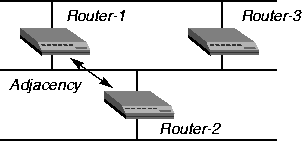
Figure 1. Adjacency between neighboring routers
Asymmetric Digital Subscriber Line. ADSL is a standard that enables modems attached to twisted-pair copper wiring to transmit data at rates from 1.5 Mbps to 9 Mbps downstream, and 16 kbps to 640 Kbps upstream. ADSL devices can transmit data at distances of up to 18,000 feet. Compare with HDSL, SDSL.
Accounting Fail-Safe record. When a call comes in and RADIUS accounting is in use, the host card first sends a Start record to the shelf controller, which stores it as an AFS record. The host card then sends one or more Start records to the RADIUS accounting server, repeating until it receives an ACK from the server. Similarly, when the call clears, the host card sends a Stop record to the shelf controller, which causes it to delete the AFS record for that session. The host card then sends the accounting server Stop records until it receives an ACK from the server. See also accounting, accounting server, proxy RADIUS accounting, Start record, Stop record
A network device (such as the MAX TNT) that provides Simple Network Management Protocol (SNMP) information to a manager application running on another computer. The agent and manager share a database of information, called the Management Information Base (MIB). The manager polls the agent for information at regular intervals. When an unusual system event occurs, the agent can use a message called a traps-PDU to send unsolicited information to the manager. See also manager, MIB, SNMP, traps-PDU.
Alarm Indication Signal. An AIS is a signal that a device sends in order to take a DS3 line or DS2 stream out of service. See also DS3 line.
See AIS.
An ITU-T standard for sampling data by means of Pulse Coded Modulation (PCM). A-Law is most commonly used outside of North America and Japan. Compare with U-Law. See also PCM.
Average Line Utilization. ALU is the average amount of bandwidth used on a line over a user-specified period of time. The MAX TNT uses ALU when determining whether to add or subtract bandwidth from a multichannel call. See also DBA.
See ANSI.
Data that can change continuously and have any value in a range. Examples of analog data are the time of day represented by clock hands, and the temperature represented by a liquid thermometer. Compare with digital data. See also analog signal.
A line that transmits data by means of an analog signal. See also analog signal.
method of testing the data paths between the HDLC controllers and the U-interface echo canceller (IEC-2091) during a session with an IDSL card. See also IDSL card, LLB, U-interface.
A V.34bis MAX TNT card that supports users who do not have access to digital services. Each 36-port Analog Modem card occupies two slots on the MAX TNT, and supports analog connections at rates of up to 33.6 Kbps. A single-shelf MAX TNT can include up to seven Analog Modem cards for 252 remote analog connections. Compare with Digital Modem card, Series56 Digital Modem card. See also analog data, V.34bis.
A type of signal that encodes data transmitted over wire or through the air, commonly represented as an oscillating wave. An analog signal can transmit analog or digital data. It takes any value in a range, and changes smoothly between values. A radio station sends analog music data using analog signals, while a modem transmits digital data using analog signals. Compare with digital signal. See also analog data.
Automatic Number Identification. ANI is a mechanism that informs the called party of the calling party's phone number. Though ANI is often thought of as an ISDN feature, it is actually part of Signaling System 7, and distinct from ISDN. See also CLID authentication, Signaling System 7.
American National Standards Institute. ANSI creates standards for networking and communications. It is the U.S. representative to the International Standards Organization (ISO). See also ISO.
A profile that sets baseline values to determine how the MAX TNT evaluates incoming calls before it accepts them. If the call does not comply with the Answer-Defaults settings, the unit rejects the call without answering it. Therefore, you must check the Answer-Defaults values to make sure they are appropriate for your site.
The MAX TNT applies the Answer-Defaults values before it routes the call to a digital modem or High-Level Data Link Control (HDLC) channel for processing, and before it locates a Connection profile or RADIUS user profile. If the caller's profile contains a parameter or attribute similar to one in the Answer-Defaults profile, but the caller's setting specifies a different value, the MAX TNT uses the value in the Connection profile or RADIUS user profile to build the session.
By default, the Answer-Defaults profile enables all types of encapsulation and routing, and the basic call-setup parameters use the lowest-common-denominator settings. The default settings are appropriate for many sites. You might want to change the settings in order to finetune the criteria by which the MAX TNT accepts calls or determines how much bandwidth is accessible to Multilink Protocol (MP) or Multilink Protocol Plus (MP+) sessions. See also Connection profile, HDLC channel, MP, MP+.
Apple's protocol suite that enables Macintosh computers to function on a network. AppleTalk works with such network operating systems as TOPS (from Sun Microsystems) and AppleShare. See also AppleTalk router, AppleTalk routing, ARA.
See ARA.
A device that sends AppleTalk packets from a source to a destination by various paths. See also AppleTalk, AppleTalk routing, ARA.
A routing configuration in which Macintosh computers can share files and services on a network. A MAX TNT configured for AppleTalk routing can receive dial-in connections from AppleTalk Remote Access (ARA) client software, Point-To-Point Protocol (PPP) dial-in software that supports AppleTalk, and AppleTalk-enabled Ascend units.
Figure 2 shows a MAX TNT that routes AppleTalk between WAN interfaces and a local AppleTalk interface.
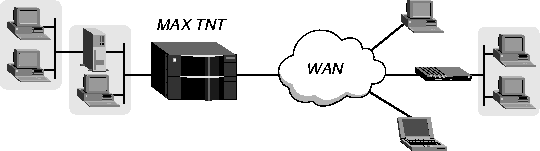
Figure 2. Routing AppleTalk between LAN and WAN interfaces
The highest layer of the OSI Reference Model. The Application layer provides applications with access to the network. File transfer, email, and network management software are examples of Application-layer programs. Protocols such as File Transfer Protocol (FTP), Rlogin, Simple Network Management Protocol (SNMP), and Telnet provide Application-layer services. See also FTP, OSI Reference Model, Rlogin, SNMP, Telnet.
AppleTalk Remote Access. ARA enables a remote Macintosh workstation to gain access to an IP network. You can use ARA over a modem or V.120 connection, or over synchronous PPP when the calling unit is an AppleTalk-enabled Ascend unit. Clients can dial in using ARA client software or a PPP dialer that supports AppleTalk. See also AppleTalk, AppleTalk router, AppleTalk routing, modem, PPP, V.120.
Attached Resource Computer Network. ARCnet is a baseband network architecture with a transmission rate of up to 2.5 Mbps. Because it is relatively inexpensive and easy to set up, ARCnet is typically used for smaller networks.
A portion of an Open Shortest Path First (OSPF) Autonomous System (AS). An area acts as its own network. All area-specific routing information stays within the area, all routers within an area have a synchronized link-state database, and each database within an area is unique. On the MAX TNT, an area number uses dotted decimal notation. It is not an IP address.
To tie the areas together, some routers belong to a backbone area and one other type of area. These routers are called Area Border Routers (ABRs). In Figure 3, all of the routers are ABRs.
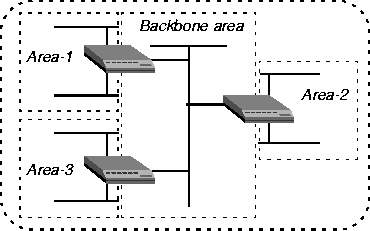
Figure 3. Dividing an AS into areas
See ABR.
Address Resolution Protocol. ARP is a protocol in the TCP/IP protocol suite. By mapping an IP address to a physical (hardware) address, ARP enables a unit to identify hosts on an Ethernet LAN. See also Ethernet, proxy ARP, TCP/IP.
Autonomous System. An AS is a group of Open Shortest Path First (OSPF) routers that exchange information, typically under the control of one company. An AS can include a large number of networks, all of which share the same AS number. All information exchanged within the AS is interior. Exterior protocols, such as Exterior Gateway Protocol (EGP), exchange routing information between one AS and another. Using an EGP, the MAX TNT imports external routes into its OSPF database and flags them as ASE (Autonomous System External). See also ASE, EGP, external route, OSPF, router.
Autonomous System Border Router. An ASBR is an Open Shortest Path First (OSPF) router that handles communication between Autonomous Systems (AS) by using an Exterior Gateway Protocol (EGP), as shown in Figure 4.
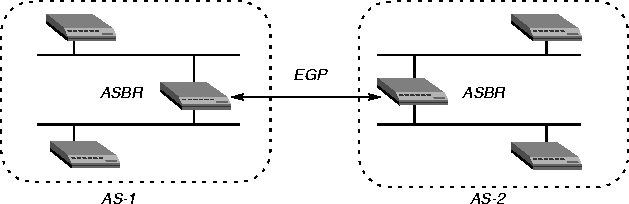
Figure 4. Autonomous System Border Routers (ASBRs)
A packet containing a notification that the MAX TNT has started up, or a making a request for the RADIUS server to record the number of open sessions. See also RADIUS server.
A response from the RADIUS server reporting that the MAX TNT has started up, or specifying the number of open sessions and informing the MAX TNT that the server has received and recorded the MAX TNT unit's ID. See also RADIUS server.
A response from the RADIUS server informing the MAX TNT that it should request access again, but with the next Personal Identification Number (PIN) in the sequence. See also RADIUS server.
A response from the RADIUS server informing the MAX TNT that it should request access again, but with the next password in the sequence. See also RADIUS server.
A response from RADIUS server to the MAX TNT, indicating that the password the user entered matches the one in the user profile, but has expired. (That is, the Access-Request packet sent a valid but expired password.) See also RADIUS server.
A response from the RADIUS server informing the MAX TNT that it should terminate the session and display the message sent in the packet. See also RADIUS server.
See ATMP.
American Standard Code for Information Interchange. ASCII is a character-encoding system for Local Area Networks (LANs). The 128 standard ASCII characters are composed of seven bits, and have the values 0-127. The extended ASCII character set contains another 128 values.
See flat ASCII users file.
Autonomous System External. The MAX TNT uses the term ASE to denote external routes it imports into its Open Shortest Path First (OSPF) database. The MAX TNT redistributes these routes by means of OSPF ASE advertisements, and propagates its OSPF routes to remote WAN routers running Routing Information Protocol (RIP). See also external route, OSPF, RIP, router.
Autonomous System External Type-5. ASE Type-5 is an external route originated by an Area Border Router (ABR) as a Link-State Advertisement (LSA). An Open Shortest Path First (OSPF) normal area allows Type-5 LSAs to be flooded throughout it.
A Not So Stubby Area (NSSA) and a stub area do not receive or originate Type-5 LSAs. However, for NSSAs, all routes imported to OSPF have the P-bit set (P stands for propagate). When the P-bit is enabled, ABRs translate Type-7 LSAs to Type-5 LSAs, which can then be flooded to the backbone. These external routes are considered Type-7 LSAs. They may be routes defined in local Connection profiles or RADIUS profiles, or static routes defined in IP-Route profiles.
Compare with ASE Type-7. See also ABR, AS, ASE, external route, LSA, normal area, NSSA, OSPF, stub area.
Autonomous System External Type-7. ASE Type-7 is a type of Link-State Advertisement (LSA) defined for Not So Stubby Areas (NSSAs) in Open Shortest Path First (OSPF) version 2. For NSSAs, all routes imported to OSPF have the P-bit set (P stands for propagate). When the P-bit is enabled, ABRs translate Type-7 LSAs to Type-5 LSAs, which can then be flooded to the backbone. These external routes are considered Type-7 LSAs. They may be routes defined in local Connection profiles or RADIUS profiles, or static routes defined in IP-Route profiles. Compare with ASE Type-5. See also AS, ASE, LSA, NSSA, OSPF, stub area.
Abstract Syntax Notation One. In the OSI Reference Model, ASN.1 is a notation for describing data structures on a network. It provides a consistent syntax for transferring data between different systems. See also OSI Reference Model.
See ADSL.
A mode for sending Point-To-Point Protocol (PPP) packets. In asynchronous mode, the characters that form the data packets are sent at irregular intervals, without a clocking signal to time transmission. Figure 5 illustrates a single-channel asynchronous PPP call in which the calling device is a modem.
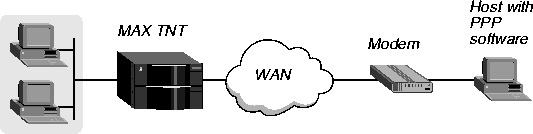
Figure 5. Asynchronous PPP connection
A mode in which the sending and receiving serial hosts know where a character begins and ends because each byte is framed with additional bits, called a start bit and a stop bit. A start bit indicates the beginning of a new character. It is always 0 (zero). A stop bit marks the end of the character. It appears after the parity bit, if one is in use.
An asynchronous link uses the type of serial communication provided by a PC COM port. A dial-up modem or V.120 Terminal Adapter (TA) initiates an asynchronous host-to-network or host-to-host connection. The call can use Point-To-Point Protocol (PPP) encapsulation, V.120 encapsulation, or raw (unencapsulated) Transport Control Protocol (TCP).
The MAX TNT routes an asynchronous call to a digital modem as a voice call, and then to the terminal-server software. If the terminal server does not detect a PPP packet, it begins a login sequence. If the terminal server detects a PPP packet, it passes the call on to the router, where it is handled as a regular PPP connection. The caller never sees the terminal-server interface.
See also asynchronous PPP, digital modem, PPP, TCP, terminal server, V.120, V.120 TA.
Asynchronous Transfer Mode. ATM is a packet-switched, broadband network architecture central to Broadband ISDN (B-ISDN). It provides very high bandwidth, enabling data, voice, and multimedia transmissions to occupy the same line. ATM is also known as cell relay. See also B-ISDN, broadband, packet switching.
Ascend Tunnel Management Protocol. ATMP provides a tunneling mechanism between two Ascend units across the Internet or a Frame Relay network. Each Ascend unit can be a MAX TNT or a Pipeline 400. The protocol uses standard Generic Routing Encapsulation (GRE) and is based on the User Datagram Protocol (UDP) and Internet Protocol (IP).
ATMP provides a Virtual Private Network (VPN) solution over the backbone resources of Internet Service Providers (ISPs) and carriers. Without ATMP, each mobile client and remote user has to dial directly into the network, resulting in long-distance charges. With ATMP, users can make a local call and have the transmission securely tunneled.
Figure 6 shows an ATMP tunnel between two MAX TNT units. A mobile client, such as a traveling salesperson, initiates the connection. The unit that authenticates the mobile client is the ATMP foreign agent. The unit that accesses the home network is the ATMP home agent. The home network is the destination network for mobile clients.
In Figure 6, the mobile client is a salesperson who logs into an ISP (the foreign agent) to access his or her home network.
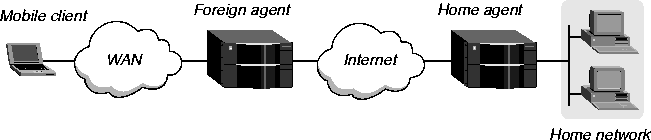
Figure 6. ATMP tunnel across the Internet
See ARCnet.
A series of values in a RADIUS user profile or pseudo-user profile. The attributes indicate a user name and password, and enable you to configure routing, call management, and usage restrictions. See also pseudo-user profile, RADIUS, RADIUS server, user profile.
Auxiliary Unit Interface. An AUI is a 15-pin D-type connector for Ethernet connections. It typically links a cable to a Network Interface Card (NIC). An AUI is also known as a Digital, Intel, Xerox (DIX) connector. See also Ethernet, NIC.
A method of identifying users permitted to access network resources. Authentication is the first line of defense against unauthorized access to your network. The MAX TNT supports a variety of authentication methods. You can use:
See also Cache-Token authentication, called-number authentication, CHAP, CLID authentication, expect-send script, PAP, PAP-Token authentication, PAP-Token-CHAP authentication, token card, token-card authentication, token-card server.
A request that the MAX TNT sends an authentication server on behalf of a client requesting access. See also authentication response, authentication server,
A response from an authentication server, notifying the MAX TNT that a user's request for access has been either granted or denied. See also authentication request, authentication server.
An external server, such as a RADIUS, TACACS, TACACS+, or token-card server, that verifies whether a user requesting access to the network has permission to use network resources. See also RADIUS, RADIUS server, TACACS, TACACS+, token-card server.
Permission for a user to carry out a certain set of tasks after he or she has access to your LAN. Authorization occurs after authentication is complete. On the MAX TNT, you configure authorization in the following profiles:
See ANI.
See AS.
See ASBR.
See AUI.
See ALU.
The part of the communications network designed to carry the bulk of the traffic. The backbone provides connectivity between subnets in an enterprise-wide network. See also enterprise-wide network, IP subnet.
An Open Shortest Path First (OSPF) area that connects routers for the purpose of hierarchical routing. The backbone area is special and always has the area number 0.0.0.0. To tie areas together, some routers belong to the backbone area and one other area. These routers are called Area Border Routers (ABRs). See also ABR, area, OSPF, router.
A network with a central cabling scheme linking it to other networks. Hosts on networks linked to the backbone can communicate with one another.
A router attached to a backbone network by nailed-up lines. Usually, a backbone router does not have any built-in digital dial-up WAN interfaces. Manufacturers of backbone routers include Cisco, Wellfleet, 3Com, and CrossCom. See also backbone network, router.
A file in which the RADIUS accounting server stores unacknowledged records. See also accounting server, RADIUS.
See BDR.
See BECN.
The amount of data a link can carry, measured bits per second (bps) for digital signals, and in hertz (Hz) for analog signals. See also analog signal, digital signal.
The number of channels to use for a Multilink Protocol (MP) connection. Because MP does not support Dynamic Bandwidth Allocation (DBA), the number of channels is fixed for the duration of the session. See also DBA, MP.
See ISDN BRI line.
A 64-Kbps channel that carries user data. A B channel is a bearer channel, one of the fundamental components of the ISDN interface. See also E1 PRI line, ISDN, ISDN BRI line, T1 PRI line.
A technique for putting multiple voice conversations on a single line. Speech is divided so that bits are transmitted only when someone is speaking. In T1 multiplexing, bundles consist of four bits, represent 11 channels of 32-Kbps compressed data, and have an associated signaling Delta channel. See also B channel.
Backup Designated Router. A BDR is the router that the Open Shortest Path First (OSPF) area uses in the event that the Designated Router (DR) goes out of service. To prevent the DR from becoming a serious liability to the network if it fails, OSPF elects a Backup Designated Router (BDR). Other routers maintain adjacencies with both the DR and BDR, but the backup router leaves as many processing tasks as possible to the DR. If the DR fails, the backup immediately becomes the DR and a new backup is elected.
The MAX TNT can function as either a DR or a BDR. However, many sites choose to assign LAN-based routers to these functions in order to dedicate the MAX TNT to WAN processing. See also adjacency, area, DR, OSPF, router.
See B channel.
An ISDN service for transmitting information from one device to another. Common bearer services are circuit-switched and Frame Relay services. See also circuit switching, Frame Relay.
Backward Explicit Congestion Notification. BECN is a bit set in a Frame Relay header to notify a source node that there is traffic congestion on the network. See also FECN, Frame Relay.
Border Gateway Protocol version 4. BGP routes packets between networks that use different types of protocols. It is known as an Exterior Gateway Protocol (EGP), and replaces an older protocol called EGP. See also EGP.
Broadband-Integrated Services Digital Network. B-ISDN is a very high-speed data service, providing data transmission at rates higher than T1 or E1. See also broadband, E1 line, ISDN, T1 line.
Binary digit, the smallest unit of information a computer can process, representing one of two states (indicated by 1 and 0).
See bps.
An interface that enables the router to handle packets whose IP address matches an unused IP address in a summarized address pool. The blackhole interface has an IP address of 127.0.0.3. When you specify this address as the router to the destination pool network, the MAX TNT silently discards packets to an invalid host on that network. See also pool summary.
Boot Protocol. BOOTP starts up a network device by using information from a server. The MAX TNT can use BOOTP to get settings and check for a new software load. In addition, you can enable the terminal server to respond to BOOTP within a Serial Line Internet Protocol (SLIP) session. An interactive user who initiates a SLIP session can get an IP address from a designated IP address pool by means of BOOTP. See also IP address, IP address pool, SLIP, terminal server.
See BOOTP.
See BGP.
A nested acronym, meaning binary digits per second, and a measure of the capacity of a line.
See ISDN BRI line.
A data communications technology that transmits data in channels and uses those channels simultaneously.
See B-ISDN.
See B-ISDN.
A network in which the router sends packets to all users, whether they appear on subscription lists or not. In an Open Shortest Path First (OSPF) topology, a broadcast network is any network that has more than two OSPF routers attached and can address a single physical message to all of them. See also OSPF, multicast network, router, unicast network.
A file that enables you to create a UNIX DBM database for use with the Ascend RADIUS daemon. See also DBM database, RADIUS daemon.
A path for signals transmitted between a computer's CPU and other hardware devices.
8 bits of data, also called an octet.
A password dynamically generated on a token card, transmitted by Challenge Handshake Authentication Protocol (CHAP), and then cached for reuse. When the MAX TNT needs to add channels or make a new call, the MAX TNT uses the cached token to authenticate the additional bandwidth. You can specify a timeout value for the cached token, or configure the system to maintain the token throughout the session. See also Cache-Token authentication, CHAP, token, token card, token-card authentication, token-card server.
An authentication method that uses Challenge Handshake Authentication Protocol (CHAP) to transmit the initial token, and then caches the token for reuse. The system later uses the cached token when the MAX TNT adds new channels or makes a new call. See also ACE authentication, cached token, SafeWord authentication, token, token card, token-card authentication, token-card server.
A single session in which a calling device and an answering device connect over the WAN.
A type of security in which you instruct the MAX TNT to hang up and call back when it receives an incoming call. You can require callback to ensure that the MAX TNT makes a connection with a known device. Hanging up and calling back adds a level of certainty that the connection is with a trusted user, especially because the MAX TNT calls back immediately after verifying the user's name and password. For the MAX TNT to use callback, it must be able to both receive and initiate calls. Callback security applies only to switched lines. See also authentication, switched line.
A form of authentication in which the MAX TNT uses the called-party number to authenticate the connection. The remote end uses this form of authentication to make sure that the call goes to a known destination. When the profile requires called-number authentication, the number called must match a phone number in a Connection profile or RADIUS user profile. The MAX TNT also uses the called number to direct incoming calls to a particular device. See also called-party number, Connection profile, user profile.
An information element of the Q.931 ISDN signaling protocol. The called-party number is the phone number the remote device calls to connect to the MAX TNT, but without a trunk group or dialing prefix specification. This number is always available if specified in a profile. See also called-number authentication.
See CLID.
A packet filter that defines which packets can bring up a connection or reset the idle timer for an established link (Figure 7). A call filter prevents unnecessary connections and helps the MAX TNT distinguish active traffic from "noise."
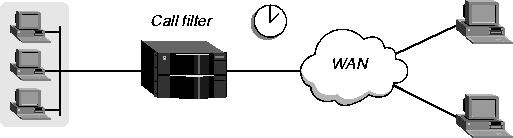
Figure 7. Call filters can prevent certain packets from resetting the timer
See CLID.
See CLID authentication.
A method of logging call information from the MAX TNT. Based on RADIUS accounting, call logging enables you to keep records for resource management or troubleshooting. When you set up call logging, you can create duplicate accounting information for sites that wish to keep accounting records separate from call logging records.
The MAX TNT sends Start session, Stop session, and Failure-to-start session packets to a call-log host. The call-log information is sent independently of RADIUS accounting records. If both call logging and RADIUS accounting are in use, the information is sent in parallel.
See also accounting, call-log host, Failure-to-start session, Start session, Stop session.
A local host that supports the RADIUS accounting protocol and is configured to communicate with the MAX TNT. See also accounting, call logging.
A profile that determines how to route calls with the MAX TNT. The MAX TNT creates a default Call-Route profile for the system itself and for each card.
The system default is the most general default Call-Route profile. It simply stops the MAX TNT from dropping calls for which it has no specified route. The system default simply says "Take any call and route it to any device in the system." It is not a very useful route, and the system expects to find more specific ones in its call-routing database.
The default Call-Route profile for the T1 card says "Take any trunk call and route it to the address of the T1 card." The default Call-Route profile for the Digital Modem card says "Route any voice call to the address of the Digital Modem card." The default Call-Route profile for the HDLC card says "Route any digital call to the address of the HDLC card."
When using a configured Call-Route profile to route a call, the MAX TNT starts with a list of all possible destinations in the system and removes certain destinations from consideration by using the following algorithm:
If the list becomes empty at any point, the MAX TNT drops the call. Depending on the type of call, the signaling being used, and the configuration of the Central Office (CO) switch, dropping the call may result in the switch returning a busy indication to the caller. If the caller receives a busy indication on a voice line, it originates from the CO switch equipment, not from the MAX TNT.
See also call routing, call-routing database, Digital Modem card, HDLC card, T1 card.
The process of directing a call to the appropriate host port (digital modem or HDLC channel) for processing. In some cases, the MAX TNT might forward a call to a Frame Relay switch or to a network host without processing the call or handling its encapsulation. In all other cases, when the MAX TNT receives a call, it routes the call to a host port for encapsulation processing before forwarding the call to the router or terminal-server software.
When the MAX TNT receives a call, it gathers the following information about it:
If the network port supports ISDN signaling, the MAX TNT is able to ascertain the bearer-capability of the call-voice or data. It can then use that information to route the call to a modem (if it is a voice-service call) or to an HDLC channel (if it is a data call). If the line is configured for inband signaling, all calls are assumed to be digital unless the T1 profile sets the default call type to voice.
See also Call-Route profile, call-routing database, digital modem, HDLC channel, host port, host-side address, network port, network-side address.
A database containing a sorted list of all installed MAX TNT devices. Using the call-routing database in conjunction with Call-Route profiles, the MAX TNT determines how to route each call it receives. The MAX TNT creates the call-routing database whenever it is reset. During active use, the sort order depends on system activity, but the initial sort order determines the order in which the MAX TNT first uses modems and HDLC channels:
See CD.
See CPERR.
Consultative Committee on International Telegraphy and Telephony. The CCITT is a disbanded organization whose standards were moved to the UN-sanctioned ITU-T on March 1, 1993.
Compression Control Protocol. CCP enables both ends of a Point-To-Point Protocol (PPP) connection to negotiate whether to use data compression, and if so, which algorithm to use.
Carrier Detect. CD is a signal sent from a modem to a host, indicating that the modem is online.
See ATM.
See CO.
See CPU.
See CHAP.
A request to change the packet filters for a routing session. See also Change-Filter-Request-ACKed packet, Change-Filter-Request-NAKed packet.
A message the MAX TNT sends if it found at least one routing session for which it could change packet filters. Compare with Change-Filter-Request-NAKed packet. See also Change-Filter-Request packet.
A message the MAX TNT sends if it could not find a routing session for which it could change packet filters. Compare with Change-Filter-Request-ACKed packet. See also Change-Filter-Request packet.
A portion of a line's bandwidth. A line contains a fixed number of channels. Each line can contain switched channels only, nailed-up channels only, or a combination of switched and nailed-up channels. See also bandwidth, line, nailed-up channel, switched channel.
A T1 PRI or E1 PRI line divided into individual 64-Kbps channels, or into channels whose data rate is a multiple of 64 Kbps (such as a 256-Kbps channel made from four 64-Kbps channels). Channelized T1 PRI or E1 PRI lines can consist of switched lines with inband signaling, or nailed-up lines. For example, a nailed-up line can run from the Central Office (CO) to the corporate headquarters as a single, unchannelized T1 PRI or E1 PRI line, and can then be divided into channels when it runs to remote sites from the corporate headquarters. See also E1 line, E1 PRI line, inband signaling, nailed-up line, switched line, T1 line, T1 PRI line, unchannelized service.
See CSU.
Challenge Handshake Authentication Protocol. CHAP authentication verifies the caller's identity by using a three-way handshake upon initial link establishment, and then by repeating the handshake any number of times. In CHAP authentication, the authentication server sends a challenge to the caller. The caller responds with an MD5 digest calculated from the password. The authentication server then checks the digest against its own calculation of the expected hash value to authenticate the call. The server can send a new challenge at random intervals.
CHAP is a stronger authentication method than Password Authentication Protocol (PAP), because the password does not travel across the line as plain text. In addition, the use of repeated challenges limits the time of exposure to any single attempt to break the encryption code, and the server is in control of how often it sends challenges. See also encryption, PAP.
A connection between endpoints over a physical medium.
A connection that follows a specified path through the Frame Relay switch. By linking two Data Link Connection Indicator (DLCI) endpoints, the MAX TNT creates a Permanent Virtual Circuit (PVC). The two DLCI endpoints act as a tunnel. A circuit connection is illustrated in Figure 8.
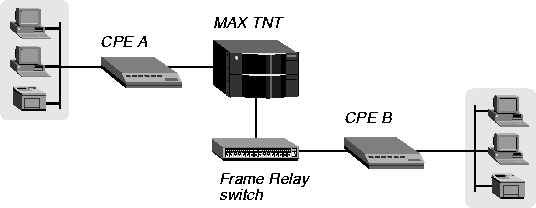
Figure 8. Circuit connection
A mode of data transfer in which a dedicated connection is busy for the duration of the call. Compare with packet switching.
See CTS.
Command-Line Interface. The CLI enables you to configure the MAX TNT by means of commands that you enter at a prompt.
Calling-Line ID. The CLID is the telco-provided phone number of the calling device that wants to connect to the MAX TNT. A CLID is also known as a caller ID. See also CLID authentication.
Calling-Line ID authentication. CLID authentication is a method the MAX TNT uses to authenticate incoming calls by checking the calling party's phone number as received from the telco. The CLID is the phone number of the calling device. The MAX TNT performs CLID authentication before enabling the MAX TNT to answer an incoming call. When the profile requires CLID authentication, the caller's phone number must match a phone number specified in a local Connection profile or RADIUS user profile. You can thereby ensure that the call comes from a known source.
You can use CLID authentication only where the call information is available end-to-end and Automatic Number Identification (ANI) applies to the call. In some areas, the WAN provider might not be able to deliver CLIDs, or a caller might keep a CLID private. Typically, a site uses CLID authentication to protect against a situation in which an unauthorized user obtains the name, password, and IP address of an authorized user, and then calls the MAX TNT from another location.
See also CLID, Connection profile, RADIUS, user profile.
A user or device that requires services from another unit or program. For example, a user requesting access is a client of the MAX TNT, and a MAX TNT making a RADIUS authentication request is a client of the RADIUS server. See also RADIUS server.
A configuration that enables the MAX TNT to direct incoming connections to a Domain Name System (DNS) server belonging to a particular client or location, thereby preventing WAN users from accessing a local DNS server. Client DNS has two levels: a global configuration that applies to all PPP connections, and a connection-specific configuration. The MAX TNT uses the global client addresses only if none are specified in the Connection profile. The addresses configured for client DNS servers are presented to WAN connections during IPCP negotiation. You can also choose to present your local DNS servers if no client servers are defined or available. See also Domain Name System, IPCP.
A file that defines the client machines permitted to make requests to the RADIUS server. For the RADIUS daemon to respond to client requests from the MAX TNT, you must enter a line specifying the MAX TNT unit's name and password in the
clients file. See also RADIUS daemon, RADIUS server.A timing mechanism for synchronizing data communication and processing tasks. A clock divides time into very short intervals. The clock speed is the number of intervals per second. See also clock source.
The master source for clocking of synchronous connections. The entire multishelf MAX TNT system uses a single synchronous clock source. The MAX TNT chooses the clock source from the T1 or E1 lines you specify as possible external sources. If there are no eligible external sources, the system uses an internal clock generated by the master shelf controller.
You can use the Clock-Source diagnostic command to determine the current master clock source. If you execute the command on the shelf controller, the output tells which slot (if any) is the clock source. If you execute the command on a T1 or E1 card, the output tells which line is the clock source.
See also clock, synchronous transmission.
Central Office. The CO is the telephone switching office to which a customer directly connects. It connects the customer to other portions of the telephone network.
COder/DECoder. A codec is a device that encodes analog data into a digital signal for transmission over a digital medium. Codecs are often used for videoconferencing. See also analog data, digital signal.
A file containing the last 20 commands entered at the MAX TNT unit's Command-Line Interface (CLI). When the buffer is full and you enter a new command, the oldest command line is deleted. See also CLI.
See CLI.
A terminal-server mode in which you can enter commands at the terminal-server prompt. Compare with immediate mode, menu mode.
A line in a RADIUS user profile or pseudo-user profile that describes the purpose of one or more lines of the profile. Beginning with the # character at column one, the comment line consists of text that extends to the end of the line. You can embed a comment line anywhere in a profile. See also pseudo-user profile, user profile.
A password that the MAX TNT sends to the Simple Network Management Protocol (SNMP) manager when an SNMP trap event occurs, and that the manager sends to the MAX TNT with each polling request. The password authenticates the sender. The default is
public. See also agent, manager, SNMP.See CSLIP.
A process that reduces the quantity of bandwidth or storage space required to encode a block of information. See also VJ compression.
A local profile containing authentication and configuration information about a remote device or user.
See CCITT.
A subprofile that resides directly below a profile, or that is nested within another subprofile. See also profile, subprofile.
The time it takes all routers to receive information about a change to the network topology. A slow convergence can result in routing loops and errors. A Routing Information Protocol (RIP) router broadcasts its entire routing table every 30 seconds. On a 15-hop network, convergence can be as high as 7.5 minutes. In contrast, Open Shortest Path First (OSPF) uses a link-state database of the network, and propagates only changes to the database, resulting in faster convergence. See also link-state database, OSPF, RIP.
See UTC.
An Open Shortest Path First (OSPF) value you assign to the output side of each router interface. The cost indicates the likelihood that the MAX TNT will use the interface to transmit data. The lower the cost, the more likely that the MAX TNT will use the interface.
Figure 9 shows how costs are used to direct traffic over high-speed links. For example, if Router-2 in Figure 9 receives packets destined for Host B, it will route them through Router-1 across two T1 links (Cost=20) rather than across one 56kbps B-channel to Router-3 (Cost=240).
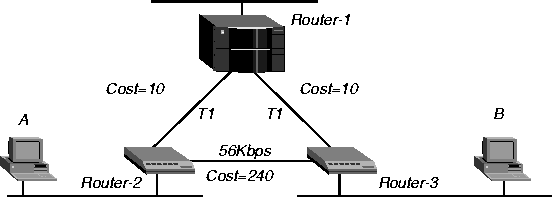
Figure 9. OSPF costs for different types of links
The MAX TNT has a default cost of 1 for a connected route (Ethernet) and 10 for a WAN link. Be careful when assigning costs. Incorrect cost metrics can cause delays and congestion on the network.
Customer Premises Equipment. CPE is equipment connected to the telephone network, and located at the customer's site. The equipment can be owned or leased.
C-bit Parity Errors. In the line-statistics display, CPERR indicates the number of times that the C-bit parity check failed on the DS3 line. Compare with PERR. See also DS3 line.
Central Processing Unit. The CPU is the computer's main processor.
Cyclic Redundancy Check. CRC is an error-detection method that uses a mathematical divisor to check the integrity of the data in a transmitted packet.
A cable with wires that cross over, so that the terminating ends of the cable have opposite wire assignments. Compare with straight-through cable.
Compressed Serial Line Internet Protocol. CSLIP is a form of the Serial Line Internet Protocol (SLIP). Both SLIP and CSLIP enable you to transmit IP packets over serial connections, but CSLIP uses a compressed packet header and involves less overhead than SLIP. See also SLIP.
Channel Service Unit. Along with a Data Service Unit (DSU), a CSU is a component of Data Circuit-terminating Equipment (DCE). A CSU connects a digital phone line to a customer's network-access equipment. It can be built into the network interface of the network-access equipment, or it can be a separate device. The CSU terminates the connection at the user's end and processes digital signals. It also prevents a faulty DSU from interfering with data transmissions on the digital line. See also DCE, digital signal, DSU.
Clear To Send. CTS is a signal sent from a receiving device to a transmitting device, indicating that the transmitter can begin sending data. A CTS signal is generally a response to a transmitter's Request To Send (RTS) signal. See also RTS.
See CPE.
See CRC.
A T1 line that uses the D4 format, also known as the Superframe format, to frame data at the physical layer. The D4 format consists of 12 consecutive frames, each one separated by framing bits. T1 lines that do not use ISDN D-channel signaling use the D4 format. See also T1 line.
A Type-2 Open Shortest Path First (OSPF) packet. OSPF routers exchange Database-Description packets when an adjacency is being initialized. Each packet describes the contents of the link-state database. The routers use a poll-response procedure. One of the routers is the master, and the other a slave. The master sends Database-Description poll packets, and the slave sends Database-Description response packets. OSPF links the responses to the polls by means of a sequence number in each packet. See also adjacency, link-state database, OSPF.
See DCE.
See DCE.
See compression.
See DES.
A packet filter that defines which packets the MAX TNT can transmit on a connection. When you apply a data filter, its forward or drop action affects the actual data stream by preventing certain packets from reaching the Ethernet from the WAN, or vice versa (Figure 10).
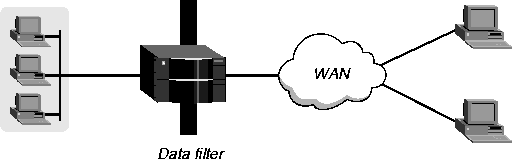
Figure 10. Data filters can drop or forward certain packets
See DDP.
See DLCI.
The second layer of the OSI Reference Model. The Data Link layer creates, sends, and receives data packets appropriate for the type of network in use. Data-Link-layer protocols include High-Level Data Link Control (HDLC), Link Access Procedure, Balanced (LAPB), Link Access Procedure, D channel (LAPD), Point-To-Point Protocol (PPP), and Serial Line Internet Protocol (SLIP). See also HDLC, LAPD, OSI Reference Model, PPP, SLIP.
A service provided over a WAN line and characterized by the unit measure of its bandwidth. A data service can transmit either data or digitized voice. The following types of data services are available: Switched-56, Switched-64, Switched-384 (also known as H0), Switched-1536 (also known as H11), MultiRate, and GloBanD. See also GloBanD, MultiRate, Switched-56, Switched-64, Switched-384, Switched-1536.
See DSU.
See DSR.
See DTE.
See DTR.
Dynamic Bandwidth Allocation. DBA denotes the process of adding or subtracting bandwidth from a switched connection in real time without terminating the link. Multilink Protocol Plus (MP+) supports DBA based upon a set of parameters you specify. To add bandwidth, the MAX TNT dials additional connections.
The MAX TNT can reject a request to add bandwidth if no more channels are available, or if the network is congested. Under either of these conditions, the two ends enter bandwidth-addition-lockout mode, in which neither side can request bandwidth. The lockout prevents both ends from continually trying to add new channels unsuccessfully. The MAX TNT and the Ascend unit at the other end of the link automatically remove the lockout restriction when the conditions that caused the lockout change. Changes typically result from plugging in a new switched-service line, reconfiguring a Line profile, or experiencing a switched-service congestion timeout. When the lockout ends, each end is free to add bandwidth.
If you use a circuit between two locations to capacity 24 hours per day, using a nailed-up line is more cost effective than using a switched line. However, if you need the circuit only sporadically, or if the circuit is sometimes underutilized, it often makes more sense to lease a smaller amount of nailed-up bandwidth and then supplement it with additional switched bandwidth as traffic requirements dictate.
For example, you might establish some connections only when you need to transfer data, and a single circuit can accommodate low traffic levels. However, if traffic levels grow beyond the capacity of the circuit (such as during a large file transfer), DBA automatically adds additional switched channels. When traffic levels subside, DBA automatically removes the channels from the connection. The bandwidth and connection costs are thereby reduced. You pay only for bandwidth when you need it.
See also bandwidth, circuit, MP+, nailed-up line, switched line.
A RADIUS users file in UNIX database format. Compare with flat ASCII users file. See also users file.
Data Circuit-terminating Equipment (also Data Communications Equipment). A DCE is a device that connects Data Terminal Equipment (DTE) to a communications channel, such as a telephone line. A DTE refers to a device that an operator uses, such as a computer or a terminal. A DCE converts the format of the data coming from the DTE into a signal suitable to the communications channel. An example of a DCE is a modem, which converts digital data from a computer to analog signals suitable for sending over a telephone line. See also analog signal, digital data, DTE, modem.
A channel that carries WAN synchronization and signaling information on a T1 PRI or E1 PRI line. See also E1 PRI line, T1 PRI line.
Datagram Delivery Protocol. DDP is an AppleTalk Network-layer protocol. It provides connectionless service between sockets, and handles both addressing and routing. See also routing, socket.
A gateway that adds Datagram Delivery Protocol (DDP) encapsulation to Internet Protocol (IP) packets it transmits, and removes DDP from IP packets it receives. This type of gateway enables the use of AppleTalk Remote Access (ARA) client software for an IP connection.
In Figure 11, the dial-in client is running ARA 3.0 (which includes DDP-IP tunneling capabilities) and Telnet to communicate with an IP host on the MAX TNT local interface. The client has its own host route.
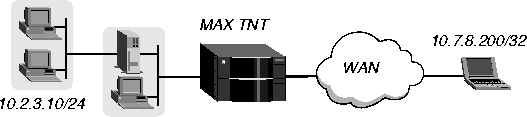
Figure 11. DDP-IP connection using ARA 3.0
Discard Eligibility. DE is a bit in a Frame Relay packet header. You set the DE bit to indicate that the network can discard the packet when traffic reaches a high level. See also Frame Relay.
The default router the Ascend unit uses for traffic from a specific connection if it finds no explicit route in the IP routing table. See also IP router, IP routing table.
The route the Ascend unit uses if it does not find a match for a packet's destination address. The default route has the destination address 0.0.0.0. If the Ascend unit finds a default route, it brings up the required connection (if necessary) and forwards the packet.
Figure 12 shows a router on a local subnet configured as the default route in a MAX TNT. This type of configuration enables the MAX TNT to turn off RIP on its local interfaces, and forward all local packets to the default route.
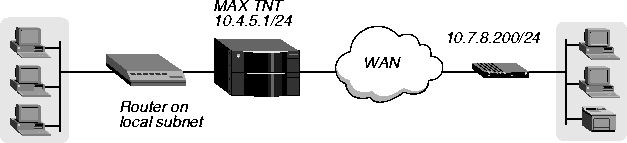
Figure 12. Default route to a local IP router
A name the RADIUS server uses to grant access to clients who do not appear in the
users file. You can configure only one Default profile. It must specify the user name Default, and it must be the last profile in the users file. See also user profile, users file.The zone assigned to an AppleTalk service on an interface if the service does not select a zone in which to reside. See also zone, zone list.
See DoS attack.
Data Encryption Standard. DES is the U.S. encryption standard for nonclassified documents. This standard uses a 64-bit key and private-key encryption. In private-key encryption, only the sender and receiver know the key for encrypting the data. DES cannot ensure that the sender and receiver are legitimate. A sender who has learned the key can fraudulently use it. See also encryption, private-key encryption.
See DR.
See DSAP.
A file containing RADIUS accounting records. See also accounting, RADIUS.
The address of a device in the MAX TNT. The device address is expressed in the format
{shelf slot item}. The following table lists each element of the syntax:
See also item number, shelf, slot.
See DNIS.
A remote user or device that calls the MAX TNT over a switched circuit and requests a connection.
A MAX TNT feature designed for sites that support many clients and connections to only a few remote IPX networks. When it receives a SAP query for a file server (service type 0x04) and its SAP table has no entry for that service type, the MAX TNT brings up all connections that enable dial query.
The Ascend RADIUS dictionary. The
dictionary file contains a list of all the attributes the RADIUS daemon supports, along with the possible values for each attribute. See also RADIUS, RADIUS daemon, RADIUS server.Data that can have only a limited number of separate values. The time of day represented by a digital clock, or the temperature represented by a digital thermometer are examples of digital data. The digital values do not change continuously, but remain at one discrete value and then change to another discrete value. Compare with analog data. See also digital signal.
A line that transmits data by means of a digital signal. See also digital signal.
An internal device in the MAX TNT that enables it to communicate over a digital line with a station connected to an analog line. Incoming modem calls and incoming digital calls come over the same digital line. The MAX TNT can accept an incoming call from the network either as a pure digital stream, or as a digital stream encoded by Pulse Coded Modulation (PCM). A PCM-encoded digital stream contains a digitized version of the analog waveform sent by a device attached to a modem.
The MAX TNT can also convert outgoing data into analog waveforms, convert these waveforms to a PCM-encoded digital stream, and send them to the network over a digital line. The network presents the data to the receiving modem in analog form over an analog line. The data looks exactly as it would appear if it had been sent by an analog-based modem. See also analog line, Digital Modem card, digital line, modem, Series56 Digital Modem card.
A MAX TNT card that provides 48 V.34 digital modems. The card can support analog or cellular connections at speeds of up to 33.6 Kbps. It enables a remote user with a modem and an analog or cellular line to dial into the MAX TNT over a T1 line. The Digital Modem card occupies two MAX TNT slots. You can install a maximum of six Digital Modem cards in a single MAX TNT shelf. See also analog data, digital modem, modem, Series56 Digital Modem card, T1 line, V.34.
A type of signal that uses a limited number of discrete values to encode data transmitted over a wire. The value of the data encoded in a digital signal depends upon the state of the signal during a particular time period. Therefore, the sender and the receiver must synchronize their clocks. Each clock runs at a baud rate, the number of times per second the state of the signal is read or set. Several clocking schemes are available, and digital signals often include clock timing cues. A digital signal can transmit analog or digital data. For example, a Compact Disc (CD) encodes music data into digital signals, while the wires between computers transmit digital data in digital signals. Compare with analog signal. See also analog data, digital data.
See DSX.
See DSL.
A feature that enables terminal-server users to have direct access to a particular Telnet port for modem dialout. See also modem dialout.
A Frame Relay connection in which the MAX TNT ignores the destination IP address in a packet from a dial-in PPP client, and uses the Data Link Connection Indicator (DLCI) to route the packet instead. In effect, the MAX TNT does not route packets from the client in the usual sense. It simply passes them on to the Frame Relay network, and assumes that another device will route the packets on the basis of the destination IP address. Figure 13 shows two incoming PPP connections redirected out to the Frame Relay network. Both direct connections (shown at the right of Figure 13) use the same DLCI number (72).
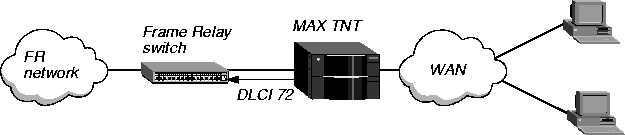
Figure 13. Frame Relay direct connections using the same DLCI
A route that can reach a destination without going through any intervening routers. See also route, router.
See DE.
A message from a client of the MAX TNT, asking the MAX TNT to disconnect the session. See also Disconnect-Request-ACKed packet, Disconnect-Request-NAKed packet.
A message the MAX TNT sends to a client if it found at least one session to disconnect. Compare with Disconnect-Request-NAKed packet. See also Disconnect-Request packet.
A message the MAX TNT sends to a client if it could not find a session to disconnect. Compare with Disconnect-Request-ACKed packet. See also Disconnect-Request packet.
A metric that uses a hop count to select the shortest route to a destination network. Routing Information Protocol (RIP) always uses the lowest hop count, regardless of the speed or reliability of a link. Compare with link-state metric. See also RIP.
See AUI.
Data Link Connection Indicator. A DLCI is a number between 16 and 991 that the Frame Relay administrator assigns. It identifies a logical link between a device and a Frame Relay switch. A Connection profile or RADIUS user profile specifies a DLCI for each user connection. The Frame Relay switch uses the DLCI to route frames through the network. The DLCI can change as frames pass through multiple switches. See also Connection profile, Frame Relay switch, user profile.
Dialed Number Information Service. DNIS is a telephone company service that provides information about the called number, such as the name and location of the target user or device.
Domain Name System. DNS is a TCP/IP service for centralized management of address resolution. Using DNS, you can specify a symbolic name instead of an IP address. A symbolic name consists of a user name and a domain name in the format username@domain_name. The user name corresponds to the host number in the IP address. The domain name corresponds to the network number in the IP address. A symbolic name might be steve@abc.com or joanne@xyz.edu. The domain identifier is the last part of the domain name, and identifies the type of organization to which the host belongs.
DNS maintains a database of network numbers and corresponding domain names. When you use a symbolic name, DNS translates the domain name into an IP address, and sends it over the network. When the Internet service provider receives the message, it uses its own database to look up the user name corresponding to the host number. See also address resolution, host number, IP address, IP network number, local DNS table.
The portion of a domain name that appears last and specifies the type of organization to which the host belongs. The Internet Network Information Center (InterNIC) provides the following domain identifiers:
The portion of a symbolic name that corresponds to the network number in the IP address. In the symbolic name steve@abc.com, the domain name is abc.com. See also IP address, IP network number.
See DNS.
Denial of Service attack. A DoS attack is a deliberate attempt to interfere with network performance by means of forged Internet Control Message Protocol (ICMP) Echo Request packets directed to IP broadcast addresses.
Under ordinary circumstances, in order to determine whether a machine on the Internet is connected and responding, a host sends an ICMP Echo Request packet. If a machine receives the packet, it returns an ICMP Echo Reply packet. In a DoS attack, however, an attacker directs ICMP Echo Request packets to IP broadcast addresses from one or more remote locations. An intermediary receives an ICMP Echo Request packet directed to the IP broadcast address of its network. If the intermediary does not filter ICMP traffic directed to IP broadcast addresses, the machines on the network receive the ICMP Echo Request packet and send an ICMP Echo Reply packet in return. The packets do not use the IP address of the source machine as the source address. Instead, they contain the spoofed source address of the intended victim. When all the machines at the intermediary's site respond to the ICMP Echo Requests, they send replies to the victim's device. An attacker can send DoS attacks to multiple intermediaries at the same time, causing all of the intermediaries to direct responses to the same victim.
Both the intermediary and victim of a DoS attack can suffer severely degraded network performance. To protect against DoS attacks, you should disable IP-directed broadcasts on the MAX TNT. By disabling these broadcasts, you deny an attacker the ability to direct IP broadcast traffic onto your network.
In addition, you should prevent the MAX TNT from responding to ICMP packets sent to IP broadcast addresses. If someone compromises a machine on your network, he or she may try to launch an attack using the MAX TNT as an intermediary, sending the ICMP Echo Request packet to the IP broadcast address of the local network. Because this traffic does not travel through a router to reach the machines on the local network, disabling IP-directed broadcasts on the MAX TNT is not sufficient to prevent a DoS attack. You must also prevent the MAX TNT from responding to ICMP packets sent to the local broadcast address. See also Echo, ICMP.
A system for specifying an IP address or subnet mask. In dotted decimal notation, each of the four portions of the IP address or mask is separated from the others by a decimal point, as in the address 200.10.5.1. See also IP address, subnet mask.
Designated Router. The DR is the router with which all other Open Shortest Path First (OSPF) routers in a broadcast network establish adjacencies. Figure 14 illustrates a configuration with both a DR and a Backup Designated Router (BDR).
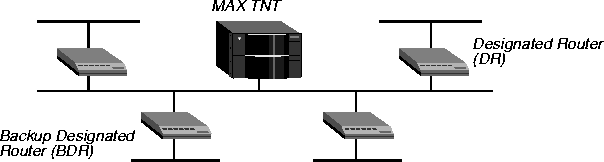
Figure 14. Designated and Backup Designated Routers
Dynamic Random Access Memory. DRAM is a kind of memory whose information resides in capacitors. The charge of each capacitor must be periodically refreshed. Compare with EEPROM, NVRAM, RAM.
A slot on the MAX TNT shelf controller that enables you to add DRAM upgrades. See also DRAM, shelf controller.
A 64-Kbps D channel on a digital line. See also DS1 channel.
For a T1 line, a 1.544-Mbps channel that consists of 24 DS0 channels and an extra framing bit; for an E1 line, a 2.048-Mbps channel that consists of 32 DS0 channels. On a T1 line, a DS1 channel uses either the D4 or ESF method of framing. See also D4-framed T1 line, DS0 channel, E1 line, ESF, T1 line, T3 card.
For a T1 line, a 6.312-Mbps channel that consists of four DS1 channels; for an E1 line, an 8.45-Mbps channel that consists of four DS1 channels. See also DS1 channel.
A 44.736-Mbps line consisting of seven DS2 channels. A DS3 line is also called a T3 line. See also DS2 channel, T3 line.
See T3 card.
Destination Service Access Point. A DSAP is the Service Access Point (SAP) address at which the Logical Link Control (LLC) layer passes information to a Network-layer process. See also SAP, SSAP.
Digital Subscriber Line. DSL is a technology that provides high bandwidth over conventional copper wiring. See also ADSL, HDSL, IDSL card, RADSL card, SDSL, SDSL card.
Data Set Ready. DSR is a signal a modem transmits when it is ready to send and receive data.
Data Service Unit. Along with a Channel Service Unit (CSU), a DSU is a component of Data Circuit-terminating Equipment (DCE). The DSU connects to Data Terminal Equipment (DTE) by means of a synchronous serial interface, such as a V.35, RS-422, or RS-423 connection. The DSU formats and controls the flow of digital data between the network and the CSU. See also CSU, DCE, digital data, DTE, RS-422, RS-423, V.35.
Digital Signal Cross-Connect. DSX is a method of connecting DS1 and DS3 signals by linking T1 and T3 lines. See also DS1 channel, DS3 line, T1 line, T3 line.
Data Terminal Equipment. A DTE is a device that an operator uses, such as a computer or a terminal. Compare with DCE.
Dual-Tone Multifrequency. DTMF is a technology enabling a touch-tone telephone to create 16 tones by means of 8 frequencies.
Data Transmit Ready. DTR is a signal indicating that a device is ready to transmit and receive data.
See DTMF.
See DBA.
The process of assigning an IP address to a dial-in caller from an IP address pool. Figure 15 shows the MAX TNT assigning an address from one of its defined pools to a dial-in host.
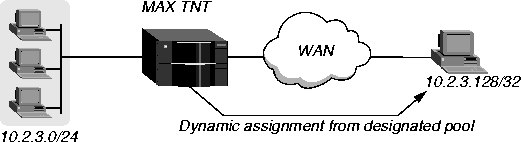
Figure 15. Dial-in host requiring assigned IP address
See DRAM.
A path to another network that the router learns by means of dynamic updates from other routers, rather than by means of a static specification in a configured profile. Routers that use Routing Information Protocol (RIP) broadcast their entire routing tables every 30 seconds, updating other routers about which routes are usable. Hosts that run Internet Control Message Protocol (ICMP) can also send ICMP Redirects to offer a better path to a destination network. Open Shortest Path First (OSPF) routers propagate link-state changes as they occur in order to update their routing tables. Compare with multipath route, static route. See also IP route, IPX route, route.
A MAX TNT card that provides eight ports, each of which can be connected to an E1 PRI line or an unchannelized E1 line. When the MAX TNT detects an E1 card, it creates a default E1 line profile for each of the eight lines on the card. See also E1 line, E1 PRI line.
A 2.048-Mbps line that supports 32 64-kbps channels, each of which can transmit and receive data or digitized voice. The line uses framing and signaling to achieve synchronous and reliable transmission. The most common configurations for E1 lines are E1 PRI and unchannelized E1. See also E1 card, E1 PRI line, unchannelized service.
E1 Primary Rate Interface line. An E1 PRI line consists of 32 64-Kbps channels. It uses 30 B channels for user data, 1 64-Kbps D channel for ISDN D-channel signaling, and one framing channel. The B channels can be all switched, all nailed up, or a combination of switched and nailed up. The E1 PRI line is a standard in Europe and Asia called CEPT G.703. Compare with ISDN BRI line, T1 PRI line, unchannelized service. See also B channel, D channel, E1 line, ISDN D-channel signaling, nailed-up channel, switched channel.
See E1 PRI line.
An 8.45-Mbps line that supports four 2.048-Mbps E1 channels.
A 34-Mbps line that supports 16 2.048-Mbps E1 channels.
External Authentication Server. See authentication server.
A signal that determines whether a node can receive and acknowledge data transmissions. A host sends an Echo Request packet. If the destination is properly connected and receives the Echo Request packet, it sends back an Echo Reply packet.
A method that the telephone company uses to remove echoes from an analog line. See also analog line.
Explicit Congestion Notification. ECN is a method of informing Frame Relay nodes that there is traffic congestion on the network. The Frame Relay header can use a Backward Explicit Congestion Notification (BECN) bit or a Forward Explicit Congestion Notification (FECN) bit to notify nodes of traffic congestion. BECN, FECN, Frame Relay.
Electronically Erasable Programmable Read-Only Memory. EEPROM is a type of Programmable Read-Only Memory (PROM) that can be erased by exposing it to an electrical charge. It retains its contents across resets and power cycles, and is similar to NVRAM. With EEPROM, data is written or erased one byte at a time; with NVRAM, data is written or erased in blocks. See also NVRAM, PROM.
Exterior Gateway Protocol. EGP is a type of protocol used to exchange routing information between one Open Shortest Path First (OSPF) Autonomous System (AS) and another. The AS number may be used by Area Border Routers (ABRs) to filter out certain EGP routing information. OSPF can make use of EGP data generated by other border routers and added to the OSPF system as Autonomous System Externals (ASEs). See also ABR, AS, ASE, OSPF.
Electronic Industries Association. The EIA is a group that determines standards for electrical transmission.
A Physical-layer standard nearly identical to V.24. EIA/TIA-232 is also known as RS-232. See also RS-232.
A Physical-layer standard also known as RS-449. See also RS-449.
A way of referring to RS-422 and RS-423. See also RS-422, RS-423.
See EIA.
See EOC.
A technique used by layered protocols in which a low-level protocol accepts a message from a higher-level protocol, and then places the message in the data portion of the lower-level frame. The logistics of encapsulation require that packets traveling over a physical network contain a sequence of headers. Encapsulation enables the transmission of data over networks that use differing protocols.
A process that takes ordinary data and converts it into a format unreadable to anyone without a decryption key. Authorized personnel with access to this key can unscramble the information. Data encryption is a useful tool against network snoopers. See also private-key encryption, public-key encryption.
An important provider of network security applications. Enigma's SafeWord AS (also known as the Enigma Logic SafeWord server) is a UNIX-based software authentication server that identifies users by means of dynamic passwords (called tokens). The server identifies users at the point of connection to a TCP/IP network, and uses standard network authentication protocols and token cards. See also SafeWord authentication, SafeWord token, token card.
A token-card authentication server from Enigma. See also Enigma, SafeWord authentication, SafeWord token, token card, token-card authentication, token-card server.
A network that contains all or most of a company's hardware and software resources. Typically, an enterprise-wide network includes computers that run different operating systems and reside on different types of networks. Therefore, achieving interoperability is the biggest challenge facing the administrator of an enterprise-wide network.
An identifier that distinguishes Call-Route profiles for the same device. See also Call-Route profile.
Embedded Operations Channel. In the BRI-U interface, EOC is the out-of-band mechanism for implementing maintenance functions. Instead of using the D or B channels, EOC uses the maintenance bits of the U-interface superframe. Maintenance functions include test loopback, statistics gathering, and requests to generate errors (to check that the block-error counters work). You can perform EOC loopback on a B channel during a session with an IDSL card. See also B channel, D channel, IDSL card.
Extended SuperFrame. ESF is a framing format that consists of 24 consecutive frames, separated by framing bits. The ISDN specification advises that you use ESF with ISDN D-channel signaling. See also ISDN D-channel signaling.
The most commonly used architecture for Local Area Networks (LANs), connecting devices such as computers, printers, and terminals. An Ethernet network uses the Physical and Data Link layers for data transmission. Ethernet incorporates a bus topology, and can operate at a rate of up to 10 Mbps. See also Data Link layer, Physical layer.
A protocol specification for the Media Access Control (MAC) header of an IPX frame. Compare with 802.2, 802.3, SNAP. See also IPX frame, MAC.
A card that provides the MAX TNT with access to Ethernet networks. Two types of Ethernet cards are available: a 10-Mbps Ethernet card and a 10/100-Mbps Ethernet card. See also 10-Mbps Ethernet card, 10/100-Mbps Ethernet card.
A device that connects workstations to standard thick or thin Ethernet-style cable. An Ethernet transceiver sends and receives information, and offers data-packet collision detection. See also Thick Ethernet, Thin Ethernet.
See parity.
A script whose lines begin with either the
send or the expect command. A line that begins with send causes all the other characters on the line to go through the WAN port running the script. A line that begins with expect causes the router to wait for matching characters from the WAN port. You can use an expect-send script to authenticate logins to the terminal server, or to start a Point-To-Point Protocol (PPP) or Serial Line Internet Protocol (SLIP) session from within a terminal-server connection. See also authentication, PPP, SLIP, terminal mode.See ECN.
See ESF.
See EGP.
A remote method of identifying the users permitted to access network resources. The remote server can be a RADIUS, TACACS, TACACS+, or token-card server. See also RADIUS, RADIUS server, TACACS, TACACS+, token-card server.
See authentication server.
A route imported into the Open Shortest Path First (OSPF) database from outside the router's Autonomous System (AS). Compare with intra-area route. See also AS, OSPF, route.
See FDL.
A RADIUS-accounting or call-logging record that contains information about a failed login attempt. See also Failure-to-start session.
An event denoting that a login attempt has failed. Information about this event appears in a RADIUS-accounting or call-logging Failure-to-start record.
See FEBE.
Fiber Distributed Data Interface. FDDI is a proposed ANSI standard for a network architecture that uses high-speed fiber-optic lines and supports transmission rates of up to 100 Mbps.
Facilities Data Link. An FDL is a 4-Kbps digital link between a sender and the telephone company's monitors. The link uses Extended Superframe (ESF) framing. The telephone company uses an FDL to check on the quality and performance of T1 lines. You cannot use FDL reporting on a line configured for D4 framing. However, you can obtain D4 and ESF performance statistics in the FDL Stats windows of the MAX TNT or in the DSX MIB. See also ESF, T1 line.
Far-End Block Error. FEBE is a signal the remote end sends to indicate that it has received DS3 or E1 frames with either Framing Errors (FERR) or C-bit Parity Errors (CPERR). A block error is detected each time the calculated checksum of the received data does not correspond to the control checksum transmitted in the successive superframe. One block error indicates that one superframe has not been transmitted correctly. No conclusion with respect to the number of bit errors can be drawn from the block-error counter. Compare with NEBE. See also CPERR, DS3 line, FERR.
Forward Explicit Congestion Notification. FECN is a bit set in a Frame Relay header to notify a destination node that there is traffic congestion on the network. Compare with BECN. See also Frame Relay.
Framing Errors. FERR indicates the number of errors in the bits used to frame the DS3 signal. See also DS3 line.
See FDDI.
See FTP.
A set of rules describing what action the MAX TNT should take when it encounters certain types of packets. A filter can apply to incoming packets, outgoing packets, or both. A packet filter applies to packets on an interface. A route filter applies to routes in Routing Information Protocol (RIP) update packets. See also packet filter, route filter.
A method of enabling a firewall to persist across connection-state changes. With filter persistence, the firewall rules stay in force even when a connection goes offline. Filter persistence applies only to interfaces you configure using the Command-Line Interface (CLI), such as Ethernet interfaces and virtual interfaces associated with Connection profiles. Filter persistence does not apply to interfaces built from RADIUS, TACACS, or TACACS+ profiles. See also CLI.
A profile containing parameters that set up filter rules. See also filter, packet filter, route filter.
See Secure Access Firewall.
See PCMCIA card.
See NVRAM.
A RADIUS users file in a flat, non-database format. Compare with DBM database. See also RADIUS, users file.
An Ascend unit that a mobile client dials into. The foreign agent is the starting point of the Ascend Tunnel Management Protocol (ATMP) tunnel. The foreign agent must be able to bring up an IP connection to the home agent, and it must authenticate the mobile client by means of a RADIUS user profile or Connection profile. See also ATMP, home agent, RADIUS, user profile.
See FECN.
A T1 or ISDN BRI line that contains both switched and nailed-up channels. See also ISDN BRI line, nailed-up channel, switched channel, T1 line.
See FT1-MP+.
In Token Ring and Systems Network Architecture (SNA), a packet at the Data Link layer of the OSI Reference Model; in Frame Relay, a packet of fixed size; in Time Division Multiplexing (TDM), a sequence of time slots, each containing a portion of a multiplexed channel. A frame contains source and destination information, flags that designate the start and end of the frame, and information about the integrity of the frame. All other data, such as network protocol information and the actual payload of data, is first encapsulated in a packet. The system then encapsulates the packet in a frame. See also Data Link layer, Frame Relay, OSI Reference Model, packet, TDM.
A synchronous protocol that encapsulates data into frames. See also framing, protocol, synchronous transmission.
A MAX TNT card that provides ten unchannelized T1 lines, each of which can be used for one nailed-up connection. Associated with each T1 line is a Serial Communications Adapter (SCA) responsible for receiving and transmitting HDLC frames. Because there is only one SCA per line, only one Point-To-Point Protocol (PPP) or Frame Relay link can be active per line. The Frame Relay link may use multiple Data Link Connection Indicators (DLCIs).
The FrameLine card provides the following PPP features:
Unlike other slot cards, the FrameLine card does not use a Call-Route profile. The data pathway is directed to an on-board SCA device and cannot be routed to another host card. All packetization of data occurs locally.
The MAX TNT supports up to 15 FrameLine cards.
See also Call-Route profile, DLCI, Frame Relay, PPP, RADIUS, SNMP, Stac LZS compression, T1 line, unchannelized service.
A WAN architecture originally developed for ISDN lines. A Frame Relay network provides high throughput by handing monitoring functions to higher-level protocols. It is a very efficient standard, with a bandwidth of up to 2 Mbps. Frame Relay is ideal for situations in which periods of very high traffic are interspersed with idle periods. It is protocol independent, and performs routing over virtual circuits called Data Link Connection Indicators (DLCIs). See also DLCI, ISDN.
A device that concentrates many low-speed, dial-in connections into one high-speed, nailed-up connection to a Frame Relay switch. When you configure the MAX TNT as a Frame Relay concentrator, it accepts incoming dial-in connections as usual and forwards them to a Frame Relay switch (Figure 16).
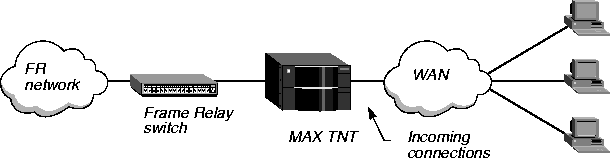
Figure 16. MAX TNT operating as a Frame Relay concentrator
A link between a dial-in user and the Frame Relay switch. The MAX TNT supports the following types of interfaces to the Frame Relay network:
A profile that defines the logical link between the MAX TNT and a Frame Relay switch. See also Frame Relay, Frame Relay switch.
A device that sends Frame Relay data out to the Frame Relay network. See also Frame Relay.
A RADIUS user profile that enables you to configure a Frame Relay connection for a user accessing a Frame Relay link. A Frame Relay user profile can specify one of three types of Frame Relay user connections: gateway, circuit, or direct. See also circuit connection, direct connection, Frame Relay, Frame Relay connection, gateway connection, user profile.
At the Physical and Data Link layers of the OSI model, a method of fitting bits into a unit called a frame. A frame contains source and destination information, flags that designate the start and end of the frame, and information about the integrity of the frame. All other data, such as network protocol information and the actual payload of data, is first encapsulated in a packet. The system then encapsulates the packet in a frame. See also Data Link layer, encapsulation, OSI Reference Model, packet, Physical layer.
See FERR.
Fractional T1 Plus Switched Multilink Protocol Plus. An FT1-MP+ connection begins as a nailed-up connection, but can later use switched channels, either to increase bandwidth or to provide a backup if the nailed-up channels go offline. When a nailed-up connection is temporarily down, the MAX TNT polls continuously while trying to re-establish the link. If an outgoing packet arrives while the nailed-up connection is still down, the unit replaces the nailed-up channel with a switched channel. See also fractional T1 line, MP+.
File Transfer Protocol. FTP is an Application-layer protocol that enables you to transfer files from one device to another over a network. See also Application layer.
A type of communications configuration in which data can be transmitted in both directions at the same time. Compare with half duplex.
A device or program that provides mapping at all seven layers of the OSI model and translates between two otherwise incompatible networks or network segments. A gateway performs code and protocol conversion to facilitate traffic between data highways of differing architectures. See also OSI Reference Model.
A routing link in a Frame Relay configuration. In a gateway connection, the MAX TNT receives an incoming Point-To-Point Protocol (PPP) call, examines the destination IP address, and brings up the appropriate Connection profile or RADIUS user profile to the destination.
Figure 17 shows callers who dial into the MAX TNT to reach a distant IP network across the Frame Relay network.
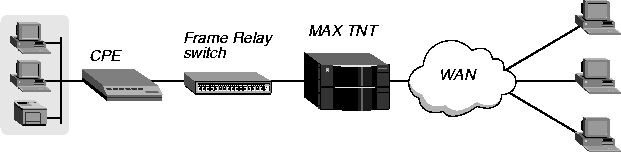
Figure 17. Gateway connection
An Ascend Tunnel Management Protocol (ATMP) configuration in which the home agent tunnels packets from the foreign agent to the home network across an open WAN connection. The WAN connection must be online. The home agent does not bring up a WAN connection to the home network in response to a packet it receives through the tunnel. For this reason, the home agent must have a nailed-up WAN connection to the home network. Compare with router mode. See also ATMP, foreign agent, home agent, home network, nailed-up circuit.
A packet filter that examines the byte- or bit-level contents of a packet and compares them with a value defined in the filter. To use a generic filter effectively, you need to know the contents of certain bytes in the packets you wish to filter. Protocol specifications are usually the best source of such information. Compare with IP filter, IPX filter. See also call filter, data filter, packet filter.
See GRE.
Gateway-To-Gateway Protocol. GGP is a TCP/IP protocol that transfers routing information between gateways. See also gateway, TCP/IP.
A signal that the switch sends when you attempt to place an outgoing call and answer an incoming call simultaneously.
A European data service consisting of a single circuit whose bandwidth is a multiple of 64 Kbps. This circuit consists of one or more B channels. For example, if a caller requests 512-Kbps service, the line uses eight B channels to supply the requested bandwidth. GloBanD service is available over T1 PRI lines only. It differs from MultiRate in being an overlay network, rather than an integral part of the worldwide switched digital infrastructure. See also bandwidth, B channel, MultiRate, T1 PRI line.
Greenwich Mean Time. This term has been changed to Coordinated Universal Time (UTC). See UTC.
Generic Routing Encapsulation. GRE provides a simple, general-purpose mechanism for encapsulating an arbitrary Network-layer protocol in another arbitrary Network-layer protocol. When a system needs to route data, it first encapsulates the information in a GRE packet. The system then encapsulates the GRE packet in a protocol supported by the network and forwards the packet to its destination.
This term has been changed to Coordinated Universal Time (UTC). See UTC.
In the Switched-384 data service, a circuit consisting of 6 B channels, or 384 Kbps. See also B channel, Switched-384.
See Switched-384.
In the Switched-1536 data service, a circuit consisting of 24 B channels, or 1536 Kbps. See also B channel, Switched-1536.
See Switched-1536.
A type of communications configuration in which data can be transmitted in only one direction at a time. Compare with full duplex.
An address assigned by the hardware manufacturer and unique to a device.
A hardware link between two devices. A hardware interface has electrical, physical, and functional specifications that determine how two devices communicate. An electrical specification defines the characteristics of the electrical signals. A physical specification might define the number of pins and wires required, and the order in which the pins and wires are laid out. The functional specification instructs the hardware on how to interpret the electrical signals. Examples of commonly used hardware interfaces are RS-232 and V.24. See also interface, RS-232, V.24.
High-Level Data Link Control. HDLC is a synchronous, bit-oriented Data Link layer protocol for data transmission. Frame Relay is an example of an HDLC-based packet protocol. HDLC offers half- or full-duplex communications over circuit- or packet-switched networks, allows point-to-point and multipoint configurations, and provides transmission over both wires and wireless media. See also circuit switching, Data Link layer, Frame Relay, full duplex, half duplex, HDLC channel, multipoint link, packet switching, point-to-point link.
High-Level Data Link Control card. On the MAX TNT, an HDLC card provides support for 128 HDLC sessions. Each ISDN call and each channel of a nailed-up connection requires an HDLC channel to process the data received from or destined for a WAN interface. You must install an HDLC card if your system uses an eight-port E1 card, an eight-port T1 card, or a T3 card.
Each HDLC card contains six HDLC controller chips. Each of these chips can handle a maximum of 32 channels. Because nailed-up connections cannot span controller chips, each nailed-up link cannot contain more than 32 channels.
An HDLC card is also known as a Hybrid Access card. See also E1 card, HDLC channel, T1 card, T3 card.
High-Level Data Link Control channel. Vital to call routing on the MAX TNT, HDLC processing removes encapsulation from high-speed incoming data calls, such as those from ISDN Terminal Adapters (TAs). After removing the link's encapsulation, the HDLC channel passes the data stream to the router. One 128-channel HDLC card supports all switched channels on an eight-port T1 card. See also HDLC, HDLC card, T1 card.
High Data Rate Digital Subscriber Line. HDSL is a technology that enables modems on either side of two copper twisted-pair wires to transmit data at T1 or E1 speeds. HDSL provides 1.544 Mbps of bandwidth each way at distances of up to 12,000 feet. T1 data rates require two lines. E1 data rates require three lines. Compare with ADSL, SDSL.
See HDSL.
See HDLC.
See HSSI.
An Ascend unit that represents the terminating part of the Ascend Tunnel Management Protocol (ATMP) tunnel. It must be able to communicate with the home network directly, through another router, or across a nailed-up WAN connection. See also ATMP, home network, nailed-up circuit, router.
A private corporate network in an Ascend Tunnel Management Protocol (ATMP) configuration. A private network is one that cannot communicate directly on the Internet, such as an IP network with an unregistered network number. See also ATMP, IP network, IPX network, IP network number.
A single message or packet transmission between host and a router, or between two routers. See also hop count, host, router.
The number of routers through which a packet passes to get from its source to its destination. See also hop, host, router.
A computer on a network, also called a node or a station.
The portion of an IP address that denotes an individual node on a network. The class of an IP address determines which portion of the address belongs to the network number and which portion belongs to the host number. See also IP address, IP network number.
A High-Level Data Link Control (HDLC) channel or a digital modem on the MAX TNT. The MAX TNT routes each call it receives to the appropriate host port. See also digital modem, HDLC channel.
An IP address with a subnet mask of 255.255.255.255, representing a single host rather than a remote router. A host route requires a static IP address. Figure 18 shows a sample connection in which a dial-in host with an ISDN modem card calls into the MAX TNT and requires a static address for a host route.
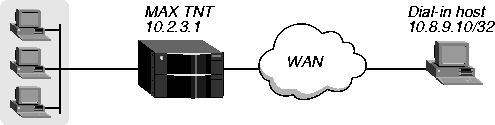
Figure 18. Dial-in host requiring a static IP address (a host route)
A connection that enables the dial-in host to keep its own IP address when logging into the MAX TNT IP network. See also host route.
The interface address of the device that terminates the WAN circuit for an incoming call to the MAX TNT. An analog-encoded call handled by a digital modem and a digital call handled by an HDLC circuit are two examples of a route to a host-side address. Compare with network-side address. See also call routing, call-routing database.
High-Speed Serial Interface. HSSI is a serial interface that operates at speeds of up to 52 Mbps, and at distances of up to 50 feet. It is similar to the RS-232 and V.35 serial interfaces, but operates at a higher speed. See also RS-232, SWAN card, V.35.
A device that serves as a termination point for multiple hosts, sending signals onto the proper paths. Typically, a hub contains four to eight connectors. In addition to providing connectors for hosts, many hubs include connectors that you can use to link one hub to another.
A group of channels that share the same phone number. When a call comes in using the phone number assigned to the hunt group, the switch hunts for an available channel in the group. See also channel, switch.
See HDLC card.
A network in which some links are capable of sending and receiving analog signals, while others handle digital signals. See also analog signal, digital signal.
Internet Control Message Protocol. ICMP is an error-reporting mechanism integral to the TCP/IP protocol suite. Gateways and hosts use ICMP to send reports of datagram problems to the sender. ICMP also includes an echo request/reply function that tests whether a destination is available and responding. See also gateway, host, TCP/IP.
A connection between endpoints in which no data is being transmitted.
A disconnect that occurs when no data is transmitted on a link for a specified period of time. See also idle timer.
A timer that measures how long a session can remain idle before the MAX TNT disconnects it. By default, any traffic across an active connection resets the connection's idle timer. When you apply a call filter, its forwarding action determines which packets can initiate a connection or reset a session's timer. When a session's idle timer expires, the MAX TNT terminates the session. The idle timer is set to 120 seconds by default, so if a connection is inactive for two minutes, the MAX TNT terminates the connection. Compare with inactivity timer. See also call filter.
Inter-Domain Routing Protocol. IDRP is an International Standards Organization (ISO) protocol for routing packets between disparate administrative domains. It is based on the Border Gateway Protocol (BGP). See also BGP, ISO.
ISDN Digital Subscriber Line card. The IDSL card supports high-bandwidth applications such as remote access, Internet access, intranet access, and telecommuting. By installing the IDSL card into the MAX TNT, you can cost-effectively support a wide range of analog, ISDN, Frame Relay and IDSL services on a single, manageable platform. Any existing ISDN U-interface device, such as a Terminal Adapter (TA) or Ascend Pipeline, can connect to a MAX TNT equipped with an IDSL card.
The IDSL card provides the following features:
Interexchange Carrier. An IEC is a type of telephone service that provides long-distance links between local telephone companies. Well-known IECs include AT&T, MCI, and Sprint. Compare with LEC.
Institute of Electrical and Electronics Engineers. The IEEE is an organization that maintains the standards for 10Base-T and other communications specifications. See also 10Base-T.
Internet Group Management Protocol. IGMP is a protocol implemented by multicast clients and routers. The MAX TNT responds as a client to IGMP packets it receives from a Multicast Backbone (MBONE) router. The packets may use IGMP version-1, IGMP version-2, or IGMP Multicast Trace (MTRACE). MAX TNT clients wanting MBONE service must implement IGMP. See also MBONE, multicast, multicast network, router.
Interior Gateway Protocol. IGP transmits routing information internal to a network. See also routing.
A terminal-server access mode in which the terminal server does not display the command-line prompt or a menu of hosts, but immediately directs a dial-in user to a designated host by means of TCP, Rlogin, or Telnet. When you use Telnet to initiate the connection to the host, you can configure the terminal server to pass the call to the host before authentication. In this case, the responsibility for authentication belongs to the Telnet host. See also Rlogin, TCP, Telnet.
A timer that determines the number of minutes that an Ascend Tunnel Management Protocol (ATMP) home agent maintains an idle tunnel before disconnecting it. Compare with idle timer.
A type of signaling in which a line uses 8 Kbps of each 64-Kbps channel for WAN synchronization and signaling. The remaining 56 Kbps handle the transmission of user data. When a line is configured for inband signaling, the MAX TNT does not receive bearer-capability information from the carrier. Therefore, it does not know whether a call uses voice service or digital service. For call-routing purposes, the MAX TNT assumes that all calls on an inband-signaling line are digital. Another term for inband signaling is robbed-bit signaling. Robbed-bit refers to the 8 Kbps of each channel used for signaling. Compare with ISDN D-channel signaling.
A call the MAX TNT receives from a remote user or device.
A name, physical address, or interface address that identifies a specific profile of a particular type. See also interface address, physical address.
A filter applied to an incoming packet. See also filter, packet filter, route filter.
See IEEE.
See ISDN.
See IDRP.
See IEC.
A connection between two devices, programs, or program elements. See also hardware interface.
A profile address composed of a physical address and logical-item number in the following format:
The{{shelf slot item}logical-item}
{shelf slot item} portion specifies the physical address. The logical-item portion specifies a logical item number. The logical item number is 0 (zero), except when the device is further divided, such as for a channelized T1 line. For a T1 line, each channel can have its own logical item number (1-24).An IP-Interface profile is an example of a profile indexed by interface address. In addition, some lines or ports contain subdivisions, such as the individual channels on a T1 line. These items have an interface address in the MAX TNT as well. See also channelized T1 PRI/E1 PRI, item number, logical item number, physical address, shelf, slot, T1 line.
An IP-routing method in which each physical or logical interface on the unit has its own IP address. The interface becomes a numbered interface. Reasons for using numbered interfaces include troubleshooting nailed-up point-to-point connections and forcing routing decisions between two links going to the same final destination. More generally, interface-based routing allows the MAX TNT to operate more as a multihomed host behaves.
You can configure each link as numbered (interface-based) or unnumbered (system-based). If no interfaces are numbered, the MAX TNT operates as a purely system-based router. Compare with system-based routing, unnumbered interface. See also IP routing, multihomed host, numbered interface, point-to-point link.
A table containing the addresses of each Ethernet, IP, and IPX interface on the MAX TNT. Each packet-handling slot card operates as a router subsystem with its own local interface table and route cache. To view the interface table, enter the Netstat command with the
-in argument, as shown in the following example:
admin> netstat -in
Name MTU Net/Dest Address Ipkts Ierr Opkts OerrThe columns in the interface table contain the following information:
ie0 1500 12.65.212.0/24 12.65.212.227 107219 0 54351 0
lo0 1500 127.0.0.1/32 127.0.0.1 4867 0 4867 0
rj0 1500 127.0.0.2/32 127.0.0.2 0 0 0 0
bh0 1500 127.0.0.3/32 127.0.0.3 0 0 0 0
wan4 1500 10.122.99.1 - 0 0 0 0
ie1-12-1 1500 11.168.6.0/24 11.168.6.227 430276 651 0 0
ie1-12-2 1500 10.122.72.0/24 10.122.72.1 0 0 0 3144
ie1-12-3 1500 10.122.73.0/24 10.122.73.1 0 0 3142 0
ie1-12-4 1500 10.122.74.0/24 10.122.74.1 0 0 3141 0
Column name |
Description |
|---|---|
Name
|
The name of the interface:
|
MTU
|
(Maximum Transmission Unit) The maximum packet size allowed on the interface.
|
Net/Dest
|
The network or the target host this interface can reach.
|
Address
|
The address of this interface.
|
Ipkts
|
The number of packets received.
|
Ierr
|
The number of packets that contain errors.
|
Opkts
|
The number of packets transmitted.
|
Oerr
|
The number of transmitted packets that contain errors.
|
See IGP.
See ISO.
See ITU-T.
A series of networks connected by gateways or routers. An internet is also called an internetwork. See also gateway, router.
The complex of WANs joining government, university, corporate and private computers in a vast web of network interconnection.
See ICMP.
A gateway for accessing the Internet. See also gateway.
See IGMP.
See InterNIC.
See IP.
See IPCP.
See ISP.
See internet.
See IPX.
Internet Network Information Center. InterNIC is an organization that provides Internet information services, oversees the registration of Internet addresses and Domain Name System (DNS) names, assigns RFC numbers, and assists users in gaining access to the Internet. See also DNS, RFC.
Compatibility with the devices and services of multiple vendors. Interoperable devices can be integrated into a network containing a wide range of vendor products. Interoperability is a significant factor among expansion considerations, because any device must have the versatility to function in an expanding network structure. The technical elements of interoperability may include a bundle of protocols and a flexible architecture to accommodate upgrades. A remote-access server should include capabilities such as translation, encapsulation, and filtering.
A route imported into the Open Shortest Path First (OSPF) database from within the router's area. Compare with external route. See also area, OSPF, route, router.
Internet Protocol. IP provides connectionless, non-guaranteed transmission of Transport-layer data packets. IP fragments packets, allowing them to take different paths across the WAN, and then reassembles them into the proper order at their destination. See also Transport layer.
An address that uniquely identifies each host on a network or internet. An IP address has a length of 32 bits, and is divided into four 8-bit parts, each separated by a period, as in 149.122.3.30. This kind of notation is called dotted decimal notation. Each part can consist of a number between 1 and 255.
An IP address consists of a network number and a host number. IP addresses come in three types: Class A, Class B, and Class C. The class of an IP address determines which portion of the address belongs to the network number and which portion belongs to the host number. The first bits of the IP address identify the class. The Internet Network Information Center (InterNIC) determines the type of class assigned a network.
A Class A address starts with 0 as the class identifier, followed by 7 bits for the network number and 24 bits for the host number.Therefore, the first number in dotted decimal form is the network number. The next three numbers make up the host number. For example, in the IP address 127.120.3.8, the network number is 127 and the host number is 120.3.8. This type of address is used by the largest organizations, because this scheme allows for over 16 million different host numbers. However, it also limits network numbers to a total of 128.
A Class B address starts with binary 10 as the class identifier, followed by 14 bits for the network number and 16 bits for the host number. Therefore, the first two dotted decimal numbers comprise the network number, and the second two dotted decimal numbers comprise the host number. For example, in the IP address 147.14.86.24, the network number is 147.14 and the host number is 86.24. More network numbers are available than in a Class A address, but fewer hosts (approximately 65,000).
A Class C address starts with binary 110 as the class identifier, followed by 21 bits for the network number and 9 bits for the host number. Therefore, the first three dotted decimal numbers comprise the network number, and the last dotted decimal number comprises the host number. For example, in the IP address 225.135.38.42, the network number is 225.135.38 and the host number is 42. Many network numbers are available, but only 254 hosts per network number. The numbers 0 and 255 are reserved.
You can tell the type of class an IP address falls into by looking at the first 8-bit portion of the dotted decimal form of the address. Class A addresses begin with a number between 0 and 127. Class B addresses begin with a number between 128 and 223. Class C addresses begin with a number between 192 and 233. In addition to an IP address, you can use a symbolic name provided by Domain Name System (DNS) to designate an Internet address. See also DNS, dotted decimal notation, host number, internet, InterNIC, IP, network, IP network number.
A pool from which the MAX TNT dynamically allocates an IP address to a calling unit. You can configure up to 128 address pools on the MAX TNT, and up to 50 in RADIUS. You can configure address pools for use only by a specific MAX TNT. See also dynamic IP, IP address.
A way for a remote device to illegally acquire a local address in order to break through a firewall or data filter.
Internet Protocol Control Protocol. IPCP is a protocol for configuring, enabling, and disabling the IP protocol modules on both ends of a point-to-point link. IPCP is tied to PPP, and is activated only when PPP reaches the Network-layer protocol phase. IPCP packets received prior to this phase are discarded. Elements of IPCP include packet encapsulation, code fields, and timeouts. See also IP, Network layer, point-to-point link.
A configuration in which the MAX TNT automatically redirects incoming IP packets to a host you specify on the local IP network. When you specify IP direction, the MAX TNT bypasses all internal routing tables, and sends all packets it receives on a connection's WAN interface to the specified IP address. Figure 19 shows an example of the traffic flow for IP direction.
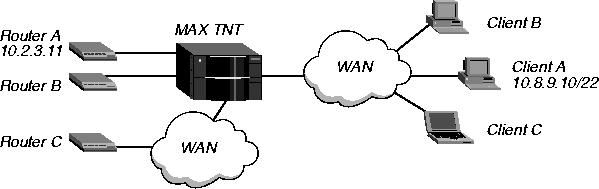
Figure 19. IP direct connections
A packet filter that examines fields specific to IP packets. An IP filter focuses on known fields, such as source or destination address and protocol number. It operates on logical information that is relatively easy to obtain. In an IP filter, a number of distinct comparisons occur in a defined order. When a comparison fails, the packet goes on to the next comparison. When a comparison succeeds, the filtering process stops and the MAX TNT applies the forward action in the filter to the packet. Compare with generic filter, IPX filter. See also call filter, data filter, packet filter.
See multicast forwarding.
A network that uses the Internet Protocol (IP) to transmit packets at the Transport layer. See also IP.
The portion of an IP address that denotes the IP network on which a host resides. The class of an IP address determines which portion of the address belongs to the network number and which portion belongs to the host number. See also host number, IP address.
A path from one IP network to another. See also dynamic route, IP network, multipath route, static route.
A cache that enables a slot card to route IP packets to another slot, reducing the route-processing overhead on the shelf controller. A route cache works as follows:
A device that sends IP packets from a source to a destination by multiple paths. As an IP router, the MAX TNT routes IP packets between its Ethernet interfaces and across any WAN interface configured for IP routing. See also IP route, IP routing.
A method of determining how to forward an IP packet to the proper destination. When acting as an IP router, the MAX TNT routes IP packets between its Ethernet interfaces and across any WAN interface configured for IP routing. Figure 20 shows a MAX TNT that routes IP packets between WAN interfaces and a LAN interface.
Figure 20. IP-routing configuration
A table that contains information about how to forward IP packets. On the MAX TNT, the routing table contains the fields Destination, Gateway, IF, Flg, Pref, Metric, Use, and Age. The following table describes each field:
See also direct route, dynamic route, gateway, hop, IP route, IP router, metric, multipath route, OSPF, preference, RIP, static route.
A portion of an IP network. IP subnetting is a way to subdivide a network into smaller networks, resulting in a greater number of hosts on a network associated a single IP network number. An IP address that uses a subnet has three elements: network, subnet, and host. You identify a subnet by combining an address with a subnet mask. For example, in the address 195.112.56.75/14, /14 is the subnet mask. See also host number, IP address, IP network number, subnet mask.
A device that can determine the destination of large volumes of incoming IP packets and send them to the appropriate outgoing ports at high speeds. An IP switch is a high-performance device designed for high-volume, large-scale public and private backbone applications. See also switch.
Internetwork Packet Exchange. IPX is Novell's connectionless Network-layer protocol. Derived from XNS' Internetwork Datagram Protocol (IDP), IPX performs addressing and routing functions. At the server, IPX passes outgoing datagrams to the network interface software. At the packet's destination, IPX passes the data to upper-layer processes. Along an IPX route, intermediate devices use IPX to route packets to their destinations. When routing, IPX relies on information supplied by the Routing Information Protocol (RIP). See also IPX network, IPX route, IPX routing, IPX server, RIP.
A user or device that gains access to the services of an IPX server. See also IPX server.
Internet Packet Exchange Control Protocol. IPXCP is a protocol for configuring, enabling, and disabling the IPX protocol modules on both ends of a point-to-point link. IPXCP is tied to PPP, and is activated only when PPP reaches the Network-layer protocol phase. IPXCP packets received prior to this phase are discarded. Elements of IPXCP include packet encapsulation, code fields, and timeouts. See also IPX, point-to-point link.
A packet filter that examines fields specific to IPX packets. An IPX filter focuses on known fields, such as source or destination address. It operates on logical information that is relatively easy to obtain. In an IPX filter, a number of distinct comparisons occur in a defined order. When a comparison fails, the packet goes on to the next comparison. When a comparison succeeds, the filtering process stops and the MAX TNT applies the forward action in the filter to the packet. Compare with generic filter, IP filter. See also call filter, data filter, packet filter.
The type of packet frame used by an IPX server. An IPX frame can follow the IEEE 802.2, IEEE 802.3, SubNetwork Access Protocol (SNAP), or Ethernet II protocol specification for the Media Access Control (MAC) header. See also 802.2, 802.3, Ethernet II, IPX server, MAC, SNAP.
A network consisting of one or more IPX servers and IPX clients. See also IPX client, IPX server, virtual IPX network.
The portion of an IPX address that denotes the IPX network on which a node resides. If the MAX TNT is routing IPX and there are other IPX servers on the LAN interface, the IPX network number assigned to the MAX TNT for that interface must be consistent with the number in use by the other routers.
If you do not specify an IPX network number in the MAX TNT configuration, the MAX TNT learns its network number from another router on the interface or from the Routing Information Protocol (RIP) packets received from the IPX router. If you specify an IPX network number in the MAX TNT configuration, the MAX TNT becomes a seed router, and other routers can learn their network number from the MAX TNT. See also IPX router, seed router.
A path from one IPX network to another. See also IPX network, IPX router.
A device that sends IPX packets from a source to a destination by various paths. See also IPX route.
A method of sending IPX packets from a source to a destination at the Network layer. A MAX TNT configured for IPX routing enables NetWare clients and distributed Novell networks to use NetWare services across the WAN. The NetWare version must be 3.11 or later. Figure 21 shows a MAX TNT that routes IPX between WAN interfaces and a local Novell network.
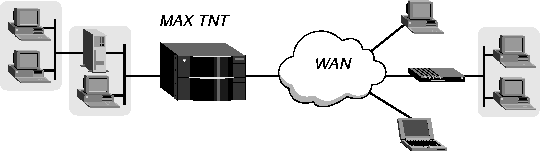
Figure 21. IPX-routing configuration
A server that runs the NetWare operating system, manages network resources, and communicates with IPX clients. See also IPX, IPX client.
A procedure that enables a device to mimic a legitimate network host and gain access to data within a private IPX network. Spoofing can lead to severe security breaches and damage the integrity of a company's operations. See also IPX network.
A type of packet that applications such as NetBIOS over IPX use to broadcast names over a network. By default, these broadcasts are not propagated over routed links (as Novell recommends) and are not forwarded over links that have less than 1 Mbps throughput. However, if you are using an application such as NetBIOS over IPX, which requires these packets in order to operate, you can enable the router to propagate IPX Type 20 packets over a LAN interface.
The WAN version of NetWare's IPX protocol. The MAX TNT supports the IPXWAN protocol, which is essential for communicating with Novell software that supports dial-in connections, and with the Multi-Protocol Router. For full specifications of the IPXWAN protocol, see RFC 1634 and NetWare Link Services Protocol Specification-IPX WAN Version 2.
When an IPX connection is brought up between two Ascend units, all options are negotiated during the IPXCP phase. IPXWAN negotiation never takes place between two Ascend units, because neither unit initiates the negotiation process by sending out an IPXWAN Timer_Request packet.
Connections with non-Ascend devices that use Novell software operating over PPP do not negotiate options during the IPXCP phase, so all options are negotiated during the IPXWAN phase of link establishment. The remote device sends an IPXWAN Timer_Request packet, which triggers IPXWAN negotiation in the MAX TNT. The devices compare internal network numbers and assign the slave role to the unit with the lower number. The other unit becomes the master of this link for the duration of the IPXWAN negotiation. The slave unit returns an IPXWAN Timer_Response packet, and the master unit initiates an exchange of information about the final router configuration. The MAX TNT supports the following routing options:
See also IPX, IPXCP, RIP, SAP.
Integrated Services Digital Network. ISDN is a telecommunications architecture capable of sending voice, data, and video in digital form on a digital line. It can support bandwidths of up to 2 Mbps, and uses a single digital line for telephone, fax, computer, and video communications. ISDN supports circuit-switched and Frame Relay connections. See also circuit switching, digital data, E1 PRI line, Frame Relay, ISDN BRI line, T1 PRI line.
See ISDN BRI line.
ISDN Basic Rate Interface line. An ISDN line uses two B channels for user data, and one 16-Kbps D channel for ISDN D-channel signaling. Both B channels can be switched, both channels can be nailed up, or one channel can be switched and the other nailed up. An ISDN BRI line can connect to standard voice service, the Switched-56 data service, or the Switched-64 data service. Compare with E1 PRI line, T1 PRI line. See also B channel, D channel, ISDN D-channel signaling, nailed-up channel, Switched-56, Switched-64, switched channel.
A type of signaling in which a D channel handles WAN synchronization and signaling, and the B channels carry the user data. Another term for ISDN D-channel signaling is out-of-band signaling. T1 PRI, E1 PRI, and ISDN BRI lines use ISDN D-channel signaling. See also B channel, D channel, E1 PRI line, ISDN BRI line, T1 PRI line.
See IDSL card.
A line that uses ISDN D-channel signaling. E1 PRI, ISDN BRI, and T1 PRI are all examples of ISDN lines. See also E1 PRI line, ISDN BRI line, ISDN D-channel signaling, T1 PRI line.
See V.120 TA.
See T1 PRI line.
See T1 PRI line.
A group of networks on the Multicast Backbone (MBONE). The islands are connected by tunnels and support IP. See also MBONE.
International Standards Organization. The ISO is an organization devoted to the definition of standards for national and international data communications. The U.S. representative to the ISO is the American National Standards Institute (ANSI). Companies whose products are ISO certified reflect a high quality of consistency and quality.
The current set of International Standards Organization (ISO) standards. See also ISO.
Internet Service Provider. An ISP is a company that provides access to the Internet. By establishing Points of Presence (POPs) containing remote-access servers and a suite of user software packages, the ISP acts as a commercial on-ramp to the Internet. Providers typically charge a monthly fee, and supply technical support and advice to customers.
A number denoting an item on a slot card. Items are numbered starting with #1 for the leftmost item on the card. An item number is part of a physical address, which has the format
{shelf slot item}. See also interface address, logical item number, physical address, shelf, slot, slot card.International Telecommunication Union-Telecommunication Standardization Sector. The ITU-T is the committee that replaced the Consultative Committee for International Telegraphy and Telephony (CCITT) on March 1, 1993. The ITU-T is responsible for a wide array of telecommunications and networking standards.
An object-oriented programming language developed by Sun Microsystems, Inc. You can use Java to create applets for distribution on the World Wide Web. Java programs run inside a Java-enabled Web browser or inside a Java Virtual Machine (JVM).
See JVM.
Java Virtual Machine. A JVM is an abstract computer that runs compiled Java code. The JVM is virtual because it is software that runs on top of a hardware platform and an operating system. All Java programs are compiled for a JVM. See also Java.
A 56-Kbps modem specification developed by Rockwell and Lucent for calls between a digital modem and an analog modem. K56flex allows 56-Kbps data transfers on the downstream portion of a call, and 33.6-Kbps data transfers on the upstream portion. The Ascend Series56 Digital Modem card includes the K56flex technology. See also digital modem, modem, Series56 Digital Modem card.
Local Area Network. A LAN is a network in which two or more computers, located within a limited distance of one another, are connected in order to share files and resources. A PC-based LAN consists of a dedicated server running a network operating system and attached to several workstations. A host-based LAN consists of one or more hosts and terminals. Examples of LAN architectures are Ethernet, ARCnet, Fiber Distributed Data Interface (FDDI), and Token Ring. See also ARCnet, FDDI, Token Ring.
See NIC.
A display of packet performance over a specified time, measured graphically or by counters.
The ability to link Local Area Networks (LANs) and Wide Area Networks (WANs). A wide range of tools, from translation protocols to communications features to support services, make a remote-access device like the MAX TNT an effective link between LANs and WANs.
Link Access Procedure. LAP is a protocol containing a subset of High-Level Data Link Protocol (HDLC) features. In order to maintain compatibility with HDLC, LAP was changed to create LAPB. See also LAPB.
Link Access Procedure, Balanced. LAPB is a protocol for B channels that use packet-switching mode. See also B channel, packet switching.
Link Access Procedure, D channel. LAPD is a protocol for the D channel. It provides the mechanism for combining multiple channels into a single logical link, and for monitoring and controlling the flow of data over the B channels. See also B channel, D channel.
Link Access Procedure, Frame. LAPF is a protocol for Frame-mode bearer services. See also bearer service.
Link Access Procedure, Modem. LAPM is an error-detection protocol for correcting data communication errors occurring on the link between two modems.
For a communications channel, the amount of time before the channel is available for a transmission; for data transmissions, the amount of time it takes for a packet to reach its destination. The following elements contribute to latency:
Link Control Protocol. LCP sets up, manages, and tears down a connection between two Point-To-Point Protocol (PPP) endpoints. See also PPP.
Line Code Violations. In the line-statistics display, LCV indicates that the MAX TNT detected either a Bipolar Violation or Excessive Zeroes on the DS3 or E1 line, indicating that one of the low-level rules for encoding data was violated on the receive signal. See also DS3 line.
See nailed-up circuit.
See nailed-up line.
Local Exchange Carrier. An LEC is a local telephone company. See also IEC.
A physical interface to the WAN. A line consists of one or more channels, each of which can transmit data. See also channel.
See LCV.
See LLB.
The status window in which T1, E1, and T3 line- and channel-status information appears. The status information can fill the upper-right portion, the lower-right portion, or the entire right side of the status window. The line-status information consists of a line identifier in shelf/slot/line format, and a two-character code indicating the line's link status. A single-character code indicates channel status. See also DS3 line, E1 line, T1 line, T3 line.
See LQM.
See LT mode.
See LAP.
See LAPB.
See LAPD.
See LAPF.
See LAPM.
A process that removes waste and redundancy from the data on a connection, enabling faster throughput. For the MAX TNT to use link compression, both sides must be configured to use the same compression method. You can use Stac compression (an Ascend-modified version of draft 0 of the CCP protocol), Stac-9 compression (the method specified by draft 9 of the Stac LZS compression protocol), or Microsoft Stac compression (the method implemented by Windows 95). See also CCP, slot compression, VJ compression.
See LCP.
The condition of an Open Shortest Path First (OSPF) link. See also OSPF.
See LSA.
A database that contains Open Shortest Path First (OSPF) routing information. Link-state routing algorithms require that all routers within a domain maintain identical link-state databases, and that the databases describe the complete topology of the domain. An OSPF router's domain may be an Autonomous System (AS) or an area within one.
Based on the exchange of information among routers, OSPF routers create a link-state database, which is updated based on packet exchanges among the routers. Link-state databases are synchronized between pairs of adjacent routers. In addition, each OSPF router uses its link-state database to calculate a self-rooted tree of shortest paths to all destinations. The routing table is built from these calculated shortest-path trees. Externally derived routing data is advertised throughout the AS but is kept separate from the link-state data. Each external route can also be tagged by the advertising router, enabling the passing of additional information between routers on the boundary of the AS.
For example, suppose you have the network topology in Figure 22.
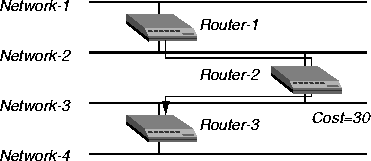
Figure 22. Sample OSPF network topology
Router-1 |
Router-2 |
Router-3 |
|---|---|---|
|
Network-1/Cost 0
|
Network-2/Cost0
|
Network-3/Cost 0
|
|
Network-2/Cost 0
|
Network-3/Cost0
|
Network-4/Cost 0
|
|
Router-2/Cost 20
|
Router-1/Cost 20
|
Router-2/Cost 30
|
|
|
Router-3/Cost 30
|
|
Each router builds a self-rooted shortest-path tree, and then calculates a routing table stating the shortest path to each destination in the AS (Figure 23, Figure 24, and Figure 25).
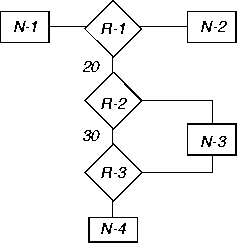
|
Destination |
Next hop |
Metric |
|
Network-1
|
Direct
|
0
| |
|
Network-2
|
Direct
|
0
| |
|
Network-3
|
Router-2
|
20
| |
|
Network-4
|
Router-2
|
50
| |
|
|
|
| |
|
|
|
|
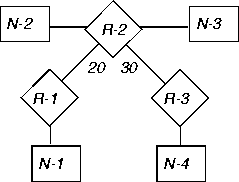
|
Destination |
Next hop |
Metric |
|
Network-1
|
Router-1
|
20
| |
|
Network-2
|
Direct
|
0
| |
|
Network-3
|
Direct
|
0
| |
|
Network-4
|
Router-2
|
30
|
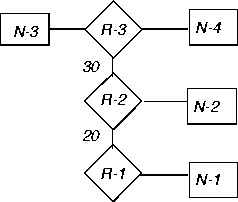
|
Destination |
Next hop |
Metric |
|
Network-1
|
Router-2
|
50
| |
|
Network-2
|
Router-2
|
30
| |
|
Network-3
|
Direct
|
0
| |
|
Network-4
|
Direct
|
0
| |
|
|
|
|
A metric that takes into account a variety of link conditions, such as the reliability or speed of the link, when determining the best path to a destination network. Open Shortest Path First (OSPF) is a link-state protocol. Compare with distance-vector metric. See also OSPF.
An Open Shortest Path First (OSPF) request for an updated database. To make routing decisions, OSPF uses a link-state database of the network and propagates only changes to the database. See also link-state database, OSPF, routing.
A packet exchanged between Open Shortest Path First (OSPF) routers for the purpose of updating link-state databases. See also OSPF, router.
Line Loopback. The LLB is a test that enables the Ascend unit to place a call to itself over the WAN, and to send a user-specified number of packets over the connection. The loopback tests the Ascend unit's ability to initiate and receive calls, and diagnoses whether the connection over the digital access line and the WAN is sound.
Logical Link Control. In the IEEE's Local Area Network/Reference Model, LLC denotes a sublayer above the Media Access Control (MAC) sublayer. Combined, the LLC and MAC sublayers are equivalent to the Data Link layer in the OSI Reference Model. They give higher-level protocols access to the physical media. See also MAC, OSI Reference Model.
See LAN.
A device directly connected to the Ascend unit or residing on the local Ethernet.
Local Domain Name System table. A local DNS table resides in RAM, and contains up to eight hostnames and IP addresses. The MAX TNT consults the local DNS table for address resolution only if requests to the DNS server fail. The local table acts as a safeguard to ensure that the MAX TNT can resolve the local set of DNS names if all DNS servers become unreachable or go down. The table can contain up to 35 IP addresses per hostname entry. Following is a sample DNS table:
Name                      IP Address       # Reads Time of last read

__________________________ _________________ ________ _______________
1: "barney" 200.65.212.12 * 2 Feb 10 10:40:44 97The table contains the following fields:
2: "rafael" 200.65.212.23 3 Feb 10 9:30:00 97
3: "donatello" 200.65.212.67 1 Feb 11 11:41:33 97
4: "wheelers" 200.65.212.9 1 Feb 12 8:35:22 97
5: "tiktok" 200.65.212.148 4 Feb 12 7:01:01 97
6: "" ------- - ---
7: "wilma" 200.65.212.8 10 Feb 15 10:02:58 97
8: "" ------- - ---
See LEC.
A profile configured on the Ascend unit, in contrast to a user profile configured in RADIUS, TACACS, or TACACS+. See also Connection profile, user profile.
A user at a device directly connected to the Ascend unit or residing on the local Ethernet.
A RADIUS file that contains error messages. You must create
logfile yourself.An address assigned by a network administrator to associate several devices with one another in a logical hierarchy or group. A router uses the logical address to help transmit a packet to its destination. An example of a logical address is an IP address. Compare with hardware address. See also IP address, router.
In an interface address, the number identifying a specific logical interface or channel on a physical line or port. The logical item number is zero except when the device has multiple interfaces or supports multiple channels. For example, a T1 line may support 24 channels, each of which is specified in a Call-Route profile by an interface address containing a logical item number from 1 to 24. See also interface address, T1 line.
The link between the MAX TNT and a Frame Relay switch, as defined in a Frame Relay profile. See also Frame Relay, Frame Relay profile, Frame Relay switch.
See LLC.
The level of event information the MAX TNT displays at the console.
Line Quality Monitoring. LQM is a feature that enables the MAX TNT to monitor the quality of a link. When you enable LQM, the MAX TNT counts the number of packets sent across the link and periodically asks the remote end how many packets it has received. Discrepancies are evidence of packet loss and indicate link-quality problems. The MAX TNT can tear down and reestablish a call if the problems on the link exceed a specified threshold.
Link-State Advertisement. An LSA is a packet that describes various aspects of an Open Shortest Path First (OSPF) route. The following LSAs are available:
See also AS, ASE, ASE Type-5, OSPF, point-to-point link, route, router.
Line Termination mode. LT mode is the termination point of a WAN connection. Typically, it is the Customer Premises Equipment (CPE).
Media Access Control. In the IEEE's Local Area Network/Reference Model, MAC denotes a sublayer below the Logical Link Control (LLC) sublayer. Combined, the LLC and MAC sublayers are equivalent to the Data Link layer in the OSI Reference Model. They give higher-level protocols access to the physical media. See also LLC, MAC address, OSI Reference Model.
The 6-byte hexadecimal address that the manufacturer assigns to the Ethernet controller for a port. See also hardware address, MAC.
See MIB.
An application that receives Simple Network Management Protocol (SNMP) information from an agent. An agent and manager share a database of information, called the Management Information Base (MIB). An agent can use a message called a traps-PDU to send unsolicited information to the manager. A manager that uses the Ascend Enterprise MIB can query the MAX TNT, set parameters, sound alarms when certain conditions appear, and perform other administrative tasks. See also agent, community name, MIB, SNMP, traps-PDU.
In a generic filter, a 12-byte value the MAX TNT applies to a packet before comparing its contents to the value you indicate in a filter specification. The mask hides the bits that appear behind each binary 0 (zero). A mask of all ones (FF:FF:FF:FF:FF:FF:FF:FF) masks no bits, so the full specified value must match the packet contents. See also generic filter.
The shelf controller that is responsible for maintaining the routing tables, and for managing each of the slot cards in the system. Compare with slave shelf controller. See also shelf controller.
See MRU.
See MRRU.
See MTU.
A multiprotocol WAN access switch that enables carriers, Internet Service Providers (ISPs), corporations, and major network providers to offer a variety of access services, such as analog, ISDN, nailed-up T1 and E 1, and Frame Relay. The MAX TNT has a scalable, modular card-and-backplane architecture that lets users design solutions that satisfy the specific application and bandwidth requirements of any customer.
The MAX TNT system hardware consists of one, two, or three shelves, a shelf controller, and redundant, load-balancing power supplies. The backplane consists of three distinct buses: Cell, Time Division Multiplexing (TDM), and Packet. It supports up to 720 simultaneous digital modem, ISDN, or 56/64-Kbps Frame Relay sessions. A single MAX TNT shelf can terminate up to 150 nailed-up T1/E1 Frame Relay lines. The system terminates a T3 and routes a full channelized T3 interface (with 720 DS0 timeslots) on a multiple-shelf system.
You can enhance the base system by adding one or more slot cards, such as a FrameLine or Analog Modem card. A single shelf can support up to 16 cards. See also analog data, Analog Modem card, Digital Modem card, DS0 channel, DS3 line, E1 line, FrameLine card, ISDN, Series56 Digital Modem card, T1 line, T3 line.
Multicast Backbone. The MBONE is a virtual network layered on top of the Internet to support IP multicast routing across point-to-point links. Because multicasting is a fast and inexpensive way to communicate information to multiple hosts, the MBONE is used for transmitting audio and video on the Internet in real time.
The MBONE consists of groups of networks called islands. These islands are connected by tunnels and support IP. When the MAX TNT accesses an MBONE network, it starts receiving MBONE multicasts. It resends the multicast packets to all of its own clients connected to it for MBONE service. The clients wanting MBONE service must implement Internet Group Membership Protocol (IGMP).
To the MBONE, the MAX TNT looks like a multicast client. It responds as a client to IGMP packets it receives from an MBONE router. The MBONE router can reside on the MAX TNT unit's Ethernet interface or across a WAN link. If the router resides across a WAN link, the MAX TNT can respond to multicast clients on its Ethernet interface as well as across the WAN.
To multicast clients on a WAN or Ethernet interface, the MAX TNT looks like a multicast router, although it simply forwards multicast packets on the basis of group memberships. See also multicast, multicast forwarding, multicast heartbeat, multicast network, multicast rate limit, point-to-point link.
The location on the MAX TNT that connects to an MBONE router. See also MBONE router.
A router that directs multicast packets to a group of clients on a subscription list. See also MBONE, MBONE interface, multicast, multicast forwarding, multicast heartbeat, multicast network, multicast rate limit.
See MAC.
A mode in which the terminal server presents a banner message and a menu of hosts. In menu mode, a user cannot enter terminal-server commands, but can connect by means of Telnet, Rlogin, or raw TCP to the hosts you specify. The MAX TNT authenticates the user's login name and password, and then displays a text-based menu such as the one shown in Figure 26.
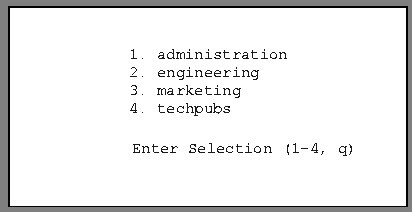
Figure 26. Menu mode
Data transmitted from one location to another with a header field, information field, and trailer. Often used interchangeably with packet and frame.
A value that determines how quickly a packet can reach its destination. Routing Information Protocol (RIP) and the Open Shortest Path First (OSPF) protocol use different types of metrics.
Mobile Host Routing Protocol. MHRP is a protocol designed to support the mobility of a host. Using MHRP, a developer can design a product allowing continuous network connectivity for traveling computer users.
Management Information Base. A MIB is a Simple Network Management Protocol (SNMP) database of information available to network management programs. An agent creates a MIB. A network manager queries the MIB for information, and might create a MIB of its own. The MIB on the agent contains machine-specific information. The manager's MIB has more general information. The MAX TNT supports SNMP MIB II, T1 MIB, and Ascend Enterprise MIBs. See also agent, manager, SNMP.
See MNP.
See MS-CHAP.
The version of the Stac LZS compression method implemented by Windows 95. Compare with Stac compression, Stac-9 compression.
Microcom Networking Protocol. MNP is a communications hardware protocol developed by Microcom, Inc. Used by many high-speed modems, MNP supports several classes of communication. A modem can support more than one class.
Class 4 provides error detection, and can vary the modem's transmission speed in accordance with the quality of the line. Class 5 offers data compression, and can enable a device to double its transmission speed. Class 6 tries to detect the highest transmission speed supported by the modem at the other end of the connection, and then attempts to transmit data at that speed. The most commonly used MNP classes are Class 4 and Class 5, also called MNP-4 and MNP-5, respectively.
See also compression, V.42.
A user or device that accesses a private home network across the Internet through an Ascend Tunnel Management Protocol (ATMP) tunnel. Using ATMP, a travelling salesperson or technical support specialist can dial into a local ISP and log into his or her home network. See also ATMP, home network.
See MHRP.
MOdulator/DEModulator. A modem is Data Circuit-terminating Equipment (DCE) installed between Data Terminal Equipment (DTE) and an analog transmission channel, such as a telephone line. (A DTE refers to a device that an operator uses, such as a computer or a terminal. The DCE connects the DTE to a communications channel, such as a telephone line.) A modem takes digital data from a DTE, translates (or modulates) the 1s and 0s into analog form, and sends the data over the channel. The receiving modem demodulates the analog signal into digital data and sends it to the DTE to which it is attached. Compare with digital modem. See also analog data, analog signal, DCE, digital data, digital signal, DTE.
A feature that enables local users to connect to the terminal server by means of Telnet, and then issue AT commands to the digital modem as though connected locally to the modem's asynchronous port. You can configure the MAX TNT for modem dialout to any Telnet port, or you can specify direct access to a particular Telnet port. See also digital modem, direct-access dialout.
Multilink Protocol. MP uses the encapsulation defined in RFC 1990, enabling the MAX TNT to interact with MP-compliant equipment from other vendors. MP is an extension of Point-To-Point Protocol (PPP) and supports the ordering of data packets across multiple channels. The MP connection shown in Figure 27 has two channels.
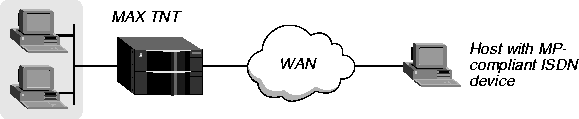
Figure 27. Multilink Protocol (MP) connection
Multilink Protocol Plus. MP+ uses Point-To-Point Protocol (PPP) encapsulation with Ascend extensions, as described in RFC 1934, to extend the capabilities of Multilink Protocol (MP). MP+ supports session and bandwidth management, enabling the MAX TNT to connect to another Ascend unit by means of multiple channels. Using MP+, you can combine up to 30 individual channels into a single high-speed connection. The connection in Figure 28 uses MP+ encapsulation between the MAX TNT and a MAX unit.
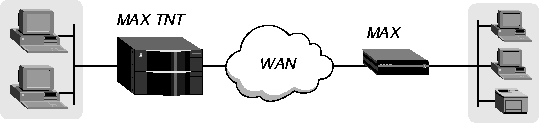
Figure 28. Multilink Protocol Plus (MP+) connection
Multilink Protocol Plus. This acronym has been superseded by MP+. See MP+.
Maximum Reconstructed Receive Unit. MRRU is a packet field that indicates that the system implements the Multilink Protocol (MP). The MRRU field is two octets, and specifies the maximum number of octets in the Information fields of reassembled packets. A system must be able to receive the full 1500-octet Information field of any reassembled PPP packet, although it may attempt to negotiate a different value. See also MP.
Maximum Receive Unit. An MRU is the largest packet that a host on a link can receive. Compare with MTU.
Microsoft CHAP. MS-CHAP is a close derivative of Challenge Handshake Authentication Protocol (CHAP). However, CHAP is designed to authenticate WAN-aware secure software, and is not widely used to support remote workstations, where an insecure plain text login might be required. MS-CHAP addresses this issue, and also integrates the encryption and hashing algorithms used on Windows networks. Microsoft Windows NT and LAN Manager platforms implement MS-CHAP. Compare with CHAP.
Maximum Transfer Unit. An MTU is the largest packet that can be transmitted over a particular medium. If a packet's size exceeds the MTU, the packet must be fragmented or segmented, and then reassembled at the receiving end. Compare with MRU.
A transmission method in which one device communicates with destination hosts by means of a single transmission to all recipients of a subscriber list. The multicast destination addresses are 224.0.0.0 to 239.255.255.255. See also MBONE, multicast forwarding, multicast heartbeat, multicast network, multicast rate limit.
See MBONE.
A route to the MBONE interface on the MAX TNT. When the MAX TNT acts as a multicast forwarder, and finds that there is no member in a particular group, it forwards multicast traffic for that group to the MBONE interface. See also MBONE, multicast forwarding.
A process by which the MAX TNT forwards traffic it receives on one of its Ethernet or WAN interfaces from an Multicast Backbone (MBONE) router. Figure 29 shows a multicast router on a WAN interface with both local and WAN multicast clients.
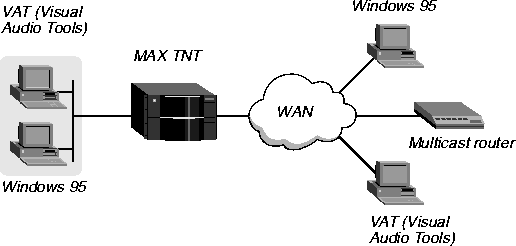
Figure 29. Forwarding multicast traffic on both Ethernet and WAN interfaces
A group of subscribers to whom a device sends multicast transmission. Membership in a multicast group is voluntary. Using Internet Group Membership Protocol (IGMP), you can configure an application on your PC to declare itself a member of a multicast group.
A feature that enables you to monitor possible connectivity problems. Using the multicast heartbeat feature, you configure the MAX TNT to poll continuously for multicast traffic. The MAX TNT generates the following SNMP alarm trap if a traffic breakdown occurs:
Trap type: TRAP_ENTERPRISEHeartbeat monitoring is optional. It is not required for multicast forwarding. To set up heartbeat monitoring, you configure several parameters that define what packets will be monitored, how often the MAX TNT polls for multicast packets, and what threshold must be reached for the MAX TNT to generate an alarm. See also MBONE, multicast, multicast forwarding, multicast network, multicast rate limit, SNMP.
Code: TRAP_MULTICAST_TREE_BROKEN (19)
Arguments:
1) Multicast group address being monitored (4 bytes),
2) Source address of last heartbeat packet received (4 bytes)
3) Slot time interval configured in seconds (4 bytes),
4) Number of slots configured (4 bytes).
5) Total number of heartbeat packets received before the MAX started sending SNMP Alarms (4 bytes).
A network in which a router sends packets to all addresses on a subscriber list. This type of network is different from both a unicast network (in which the router sends packets to one user at a time) and a broadcast network (in which the router sends packets to all users, whether they appear on subscription lists or not). The Multicast Backbone (MBONE) is an example of a multicast network. See also MBONE, multicast, multicast forwarding, multicast heartbeat, multicast rate limit.
A way to limit the rate at which the MAX TNT accepts multicast packets from its clients. To begin forwarding multicast traffic on the MBONE interface, you must set the multicast rate limit to a number less than 100. For example if you set the limit to 5, the MAX TNT accepts a packet from multicast clients on the interface every 5 seconds. Any subsequent packets received in that 5-second window are discarded. See also MBONE, MBONE interface, multicast, multicast forwarding, multicast heartbeat, multicast network.
A single Internet device connected to multiple data paths. Each link may reside on a different network.
See MP.
See MP+.
A MAX TNT that acts as either a home agent or a foreign agent on a tunnel-by-tunnel basis in an Ascend Tunnel Management Protocol (ATMP) configuration.
In Figure 30, the MAX TNT operates as a home agent for network B and as a foreign agent for network A.
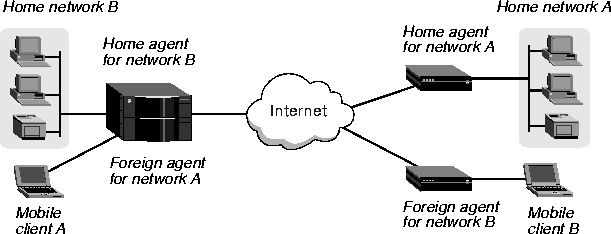
Figure 30. MAX TNT acting as both home agent and foreign agent
A static route that distributes the traffic load across multiple interfaces to a single destination. See also route, static route.
A connection that links multiple hosts on a single line.
A data service on a circuit consisting of multiple B channels. The bandwidth of the circuit must be a multiple of 64 Kbps. For example, a user can dial a first call at 384 Kbps (using 6 B channels), and then dial a second call at 512 Kbps (using 8 B channels). MultiRate service is available over T1 PRI lines only. MultiRate is also known as the Switched Nx64 data service. See also B channel, T1 PRI line.
A MAX TNT that combines multiple interleaved shelves in a chassis.
A channel on a line rented from the phone company for exclusive use, 24 hours per day, seven days per week. See also nailed-up circuit, nailed-up line.
A permanent connection between endpoints over which two parties exchange data. The number of nailed-up channels must be the same at both ends of the connection. For example, if there are five nailed-up channels at the local end, there must be five nailed-up channels at the remote end. However, channel assignments do not have to match. For example, channel 1 may be switched at the local end and nailed up at the remote end. A nailed-up circuit is also known as a private circuit or a leased circuit. See also nailed-up channel, nailed-up line.
A line rented from the phone company for exclusive use, 24 hours per day, seven days per week. The connection exists between two predetermined points and cannot be switched to other locations. A nailed-up line is also called a leased line. See also nailed-up channel, nailed-up circuit.
A form of authentication in which the MAX TNT attempts to match a caller's user name and password to the parameters or attributes specified in a profile. If name and password authentication is required, the MAX TNT first attempts to match the caller's name and password to a local Connection profile. If authentication succeeds using a local Connection profile, the MAX TNT uses the parameters specified in the profile to build the connection.
If it cannot find a matching Connection profile, the MAX TNT looks for a RADIUS, TACACS, or TACACS+ profile containing a matching name and password. If authentication succeeds using a RADIUS user profile, the MAX TNT uses the specified RADIUS attributes to build the connection. The MAX TNT can then forward the call to its router or other destination. If authentication succeeds using a TACACS or TACACS+ profile, the MAX TNT must make a request to the server for information about the resources and services the user can access.
See also authentication, Connection profile, RADIUS, RADIUS server, TACACS, TACACS+, user profile.
Network Access Server. An NAS is a device that provides LAN and WAN access for network hosts. The MAX TNT is an example of an NAS.
NetWare Core Protocol. NCP is a protocol that allows an IPX server to respond to client requests. See also IPX server.
Network Control Protocol. NCP is a collection of protocols for setting up and configuring Network-layer protocols (such as AppleTalk) over PPP. See also PPP.
See NEBE.
Near-End Block Error. A signal that the remote end sends to indicate that it has detected an error in the data it has transmitted. A block error is detected each time the calculated checksum of the data does not correspond to the control checksum transmitted in the successive superframe. One block error indicates that one superframe has not been transmitted correctly. No conclusion with respect to the number of bit errors can be drawn. Compare with FEBE.
Network Basic Input/Output System. NetBIOS is a protocol developed by IBM that provides network access to upper-layer programs. NetBIOS functionality includes the Session, Presentation, and Application layers of the OSI Reference Model, and provides naming services, connectionless best-effort datagram delivery, and support for virtual circuits. See also OSI Reference Model.
See NCP.
See IPX server.
A group of computers, often called hosts, nodes, or stations, that are connected to each other for the purpose of sharing files and other resources. Each computer has a Network Interface Card (NIC) that enables it to gain access to the network. Each host can have one or more peripherals (such as a fax modem or printer) attached to it. Each peripheral can be shared with other network users, or can remain private to the individual computer.
See NAS.
See NIC.
An address shared by all the hosts on the same physical network.
A method of setting up IP address pools for pool summary. When you perform network alignment, you make sure that the first address in the pool is the first host address, and that the maximum number of entries you specify is two fewer than the total number of addresses in the pool. See also IP address, pool summary.
See NetBIOS.
See NIC.
See NCP.
See NFS.
See InterNIC.
See NIS.
See NIC.
A layer in the OSI Reference Model. The Network layer provides address resolution and routing protocols. Address resolution enables the Network layer to determine a unique network address for a node. Routing protocols allow data to flow between networks and reach their proper destination. Examples of Network-layer protocols are Address Resolution Protocol (ARP), Datagram Delivery Protocol (DDP), Internet Control Message Protocol (ICMP), Interior Gateway Protocol (IGP), Internet Protocol (IP), Internetwork Packet Exchange (IPX), and Packet Layer Protocol (PLP). See also ARP, DDP, ICMP, IGP, IP, IPX, OSI Reference Model, routing.
See IP network number, IPX network number.
A T1 or E1 channel. The MAX TNT always places or receives calls on a network port.
A contiguous range of integers (from 1 to 65, 199) assigned to an AppleTalk network. Each network range must be unique. No two networks can use the same range, and no two network ranges can overlap.
In order for the MAX TNT to receive calls from dial-in AppleTalk Remote Access (ARA) clients, you must define a virtual AppleTalk network by specifying a network range. Each number in the range can be associated with up to 253 nodes, so the range determines how many AppleTalk clients can dial into the MAX TNT. For example, a network with a range from 1000 to 1002 could support up to 2 x 253, or 506 clients.
See also AppleTalk routing, ARA, virtual AppleTalk network.
The interface address of the line on which the MAX TNT sends an outgoing call. A call switched to a local ISDN BRI line is an example of a route to a network-side address. Compare with host-side address. See also call routing, call-routing database.
See NNI.
See NVT.
See NVT ASCII.
Non-Facility Associated Signaling. NFAS is a special case of ISDN signaling in which two or more T1 PRI lines use the same D channel, and you can add a backup D channel. It is required for the Switched-1536 data service. Because all 24 channels of the T1 PRI line carry user data, the D channel must be on another line. See also D channel, Switched-1536, T1 PRI line.
Network File System. NFS is an Application-layer protocol, developed by Sun Microsystems, for sharing and transferring remote files on UNIX or other types of networks. See also Application layer.
See InterNIC.
Network Interface Card. A NIC enables a PC to connect to a network. The NIC uses drivers to communicate with the host's networking software, and interacts with the physical media that connects the host to other computers. A NIC is also called a LAN adapter, network adapter, or network board.
Network Information Service. Along with the Network File System (NFS), the NIS is a method of creating a distributed database system in order to centralize common configuration files, such as the UNIX password file (
/etc/passwd) and the hosts file (/etc/hosts). An NIS server manages copies of the database files, and NIS clients request information from them. NIS was developed by Sun Microsystems. See also NFS.Network-To-Network Interface. A standard that defines the interface between two Frame Relay switches located in a private or public network. Both switches must reside in the same type of network. The User-To-Network Interface (UNI) standard defines the interface between a public switch and private one. NNI operation enables the MAX TNT to act as a Frame Relay switch communicating with another Frame Relay switch.
Figure 31 illustrates an NNI interface.
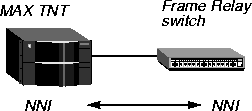
Figure 31. NNI interfaces
See host.
A value assigned to a host on a network. The node number can be hardcoded in the Network Interface Card (NIC), or assigned by means of jumper settings. It is unique among all the hosts on a local, physical network. The address for a host also contains the network address shared by all the hosts on the local network. See also host, network address, NIC.
See NFAS.
An IPX or AppleTalk router that acquires its network configuration from another router on the network. Compare with seed router. See also AppleTalk routing, IPX router.
See NVRAM.
An Open Shortest Path First (OSPF) area that allows Type-5 Link-State Advertisements (LSAs) to be flooded throughout it. Area Border Routers (ABRs) advertise external routes as Type-5 LSAs. A normal area is the default for the MAX TNT. If you change the default for one interface on the unit, you must change it for all interfaces, because the MAX TNT does not currently perform ABR functions. Compare with NSSA, stub area. See also ABR, area, ASE Type-5, external route, LSA, OSPF, router, routing.
See NSSA.
Not So Stubby Area. An NSSA is an Open Shortest Path First (OSPF) area that does not receive or originate Type-5 Link-State Advertisements (LSAs), and that imports Autonomous System (AS) external routes in a limited fashion. OSPF version 2 defines a new Type-7 LSA for NSSAs.
For NSSAs, all routes imported to OSPF have the P-bit set (P stands for propagate). When the P-bit is enabled, Area Border Routers (ABRs) translate Type-7 LSAs to Type-5 LSAs, which can then be flooded to the backbone. These external routes are considered Type-7 LSAs. They may be routes defined in local Connection profiles or RADIUS profiles, or static routes defined in IP-Route profiles.
Compare with normal area, stub area. See also area, AS, ASE Type-5, ASE Type-7, external route, LSA, OSPF.
Network Terminator Type 1. An NT1 is a terminating device for an ISDN BRI line. Installed at the subscriber's location, an NT1 provides line maintenance, timing, and echo cancellation. An NT1 can be a standalone device, or it can be built into other types of equipment. See also ISDN BRI line.
In interface-based IP routing, a unique address assigned to one side of a connection. Assignment of a unique address is a requirement for some applications, such as Simple Network Management Protocol (SNMP). Figure 32 shows a local interface with two addresses, one of which is used for a numbered interface connection.

Figure 32. How numbered interfaces work
Nonvolatile Random Access Memory. NVRAM is a type of memory that maintains its data contents across resets and power cycles. It is useful for storing configuration information across sessions. Data is written and erased in blocks, rather than byte-by-byte.
The MAX TNT unit's system configuration is stored in the onboard NVRAM. Some error conditions may require that you clear the MAX TNT configuration and reboot. When you clear NVRAM, the system is re-initialized and comes up unconfigured, just as it was when you first installed it. You can then restore the configuration from a recent backup.
NVRAM is also called flash memory. Compare with DRAM, EEPROM, RAM.
Network Virtual Terminal. An NVT is a bidirectional character device with a printer and a keyboard. The printer responds to incoming data, and the keyboard produces outgoing data sent over a Telnet connection. The code set is seven-bit ASCII in an eight-bit field. See also NVT ASCII, Telnet session.
The ASCII character set used with a Network Virtual Terminal (NVT). See also ASCII, NVT.
Eight data bits, also called a byte.
See parity.
See OSPF.
See OSI Reference Model.
Open Systems Interconnection Reference Model. The OSI Reference Model describes the layers of a network, details the functions of each layer, and explains how to connect communications devices on a LAN or WAN. Each layer provides services for the layer above it, and uses the services of the layer below it. The seven layers are:
Open Shortest Path First. OSPF is the next generation Internet routing protocol. The Open in its name refers to the fact that OSPF was developed in the public domain as an open specification. The Shortest Path First portion refers to an algorithm developed by Dijkstra in 1978 for building a self-rooted shortest-path tree from which routing tables can be derived. As a link-state protocol, OSPF an take into account a variety of link conditions, such as the reliability or speed of the link, when determining the best path to a destination network. OSPF uses a link-state database of the network and propagates only changes to the database. See also link-state database, route, router, routing.
A call that the MAX TNT places to another device.
A management method that uses a separate channel for diagnostic and administrative purposes (rather than a portion of each data channel).
See ISDN D-channel signaling.
A condition in which the DS3 line or DS2 stream cannot receive or transmit data because the MAX TNT has lost the frame alignment on the received signal. See also DS3 line.
A filter applied to an outgoing packet. See also filter, packet filter, route filter.
A block of information containing a header, data, and trailer. Packets created at one level of the OSI Reference Model are inserted into lower-level packets. The format of a packet depends upon the protocol that creates it. A packet can be transmitted over a network or phone line. Compare with frame. See also OSI Reference Model, packet field.
In a TCP dial-in session that does not require V.120 processing, a method of buffering and transmitting raw TCP data as TCP packets, rather than as a continuous data stream. Unless V.120 processing is required, raw TCP WAN data goes directly to the HDLC interface, rather than to the terminal-server subsystem. If V.120 processing is required, the terminal server processes the call. See also Raw TCP.
A portion of a packet that contains a specific kind of information. For example, the data field in a packet contains the data being transmitted between applications. The header field can contain information identifying the packet type and any error-checking mechanisms. See also packet.
A series of rules stating how the MAX TNT is to handle certain types of packets. Each rule specifies a condition and an action to be taken if the condition is met. The MAX TNT compares data in the packet to each condition, one condition at a time, until it finds a match between the data and one of the conditions. It then forwards or drops the packet, depending on the action specified for the condition.
When no filter is in use, the MAX TNT forwards all packets. But when you apply a filter to an interface, you reverse that default. For security purposes, the unit no longer forwards non-matching packets automatically. It requires a rule that explicitly allows those packets to pass.
You can apply a packet filter to incoming packets, outgoing packets, or both. In addition, you can specify that the MAX TNT forward or drop those packets that match the rules, or all packets except those that match the rules.
The MAX TNT supports three types of packet filters: generic, IP, and IPX. You can apply a generic, IP, or IPX filter as either a data filter or a call filter. The MAX TNT applies a data filter before a call filter.
Compare with route filter. See also call filter, data filter, generic filter, IP filter.
A mode of data transfer in which packets are transmitted from a specific source to a specific destination using any available circuit. Packets may take different paths at the same time, and may not arrive in the order in which they were sent. Compare with circuit switching.
Password Authentication Protocol. PAP uses a two-way handshake method of establishing a caller's identity. Used only during the initial establishment of the data link, PAP is not a strong authentication method. Passwords travel across the line as plain text, so they are subject to eavesdroppers using software that monitors network information. Use PAP authentication only when the dial-in device does not support a stronger authentication method, such as Challenge Handshake Authentication Protocol (CHAP), or when the remote device requires a plain text password.
An extension of PAP adds the U.S. Data Encryption Standard (DES) cipher to data transmissions. The caller applies the encryption algorithm to a PPP packet and places the resulting cipher text in the information field of another PPP packet. The receiving end applies the inverse algorithm and interprets the resulting plain text as if it were a PPP packet that had arrived directly on the interface.
Compare with CHAP. See also authentication, DES, password, PPP.
An extension of Password Authentication Protocol (PAP) authentication. In PAP-Token authentication, the user authenticates his or her identity by entering a password (called a token). The token is derived from a hardware device, such as a hand-held token card. The MAX TNT prompts the user for the token, possibly along with a challenge key. The MAX TNT obtains the challenge key from a token-card server that it accesses through RADIUS. The token travels in the clear, but because it is a one-time-only password, the security risk is usually not serious. To authenticate the base channel of the connection, the token-card server uses the token that the user sends in response to the challenge.
PAP-Token is appropriate for single-channel, dial-out calls. It is not practical for multichannel calls, because any time that bandwidth requirements cause another channel to come up, the MAX TNT challenges the user for another token.
Compare with PAP, PAP-Token-CHAP authentication. See also RADIUS, token, token card, token-card authentication, token-card server.
An authentication method that uses PAP-Token to authenticate the base channel of Multilink Protocol Plus (MP+) call, and then a Challenge Handshake Authentication Protocol (CHAP) password to authenticate additional channels. The advantage of a PAP-Token-CHAP call over a PAP-Token call is that you need to verify only the initial connection by means of a hand-held token card. In a PAP-Token-CHAP call, the MAX TNT uses CHAP to verify any additional channels. Compare with CHAP, PAP, PAP-Token authentication. See also MP+, token, token card, token-card authentication, token-card server.
A way for the MAX TNT to add channels to an outgoing call in multiples, rather than one at a time.
In 7-bit communication, a way for a device to determine whether it has received data exactly as the sending device transmitted it. Each device must determine whether it will use even parity, odd parity, or no parity.
The sending device adds the 1s in each string it sends and determines whether the sum is even or odd. Then, it adds an extra bit, called a parity bit, to the string. If even parity is in use, the parity bit makes the sum of the bits even. If odd parity is in use, the parity bit makes the sum of the bits odd. For example, if a device sends the binary number 1010101 under even parity, it adds a 0 (zero) to the end of the byte, because the sum of the 1s is already even. However, if it sends the same number under odd parity, it adds a 1 to the end of the byte in order to make the sum of the 1s an odd number.
The receiving device checks whether the sum of 1s in a character is even or odd. If the device is using even parity, the sum of 1s in a character should be even. If the device is using odd parity, the sums of bits in a character should be odd. If the sum of the bits does not equal the parity setting, the receiving device knows that an error has occurred during the transmission of the data.
For special ASCII characters (128-256), eight bits are necessary to represent the data. In 8-bit communication, no parity bit is used. See also ASCII.
An extra bit added to a string in 7-bit communication. The sending device adds the 1s in each string it sends and determines whether the sum is even or odd. Then, it adds the parity bit to the string. If even parity is in use, the parity bit makes the sum of the bits even. If odd parity is in use, the parity bit makes the sum of the bits odd.
A text string that a user must enter during the login process. Entering the proper password identifies the user as a person authorized to access network resources. Compare with token.
See PERR.
Pulse Coded Modulation. PCM is a sampling technique for encoding a digital stream so that it contains a digitized version of the analog waveform sent by a device attached to a modem. The MAX TNT can also convert outgoing data into analog waveforms, change these waveforms into a PCM-encoded digital stream, and send them to the network over a digital line. The network presents the data to the receiving modem in analog form over an analog line. The data looks exactly as it would appear if it had been sent by an analog-based modem.
There are two standards for coding the sample level. The U-Law standard is common in North America and Japan. Elsewhere, the A-Law standard is typically in use.
See also analog line, digital line, modem.
Personal Computer Memory Card International Association. PCMCIA is a standard that supports the devices on a credit-card-sized board. The 1990 PCMCIA version 1.0 specification supports Type I cards for RAM, ROM, or NVRAM. The 1991 PCMCIA version 2.01 specification supports Type II cards for network and fax/modem functionality, and Type III cards. A Type III card provides a miniature hard drive for wireless networks. See also NVRAM, RAM, ROM.
A card on the shelf controller that contains code for the slot cards, shelf-controller run-time code, and profiles. A PCMCIA card is also called a flash card. See also PCMCIA, PCMCIA card code, PCMCIA slot.
Code written to make use of PCMCIA-card functionality. See also PCMCIA, PCMCIA card, PCMCIA slot.
A slot on the MAX TNT shelf controller into which you can install a PCMCIA card. The MAX TNT contains two PCMCIA slots. See also PCMCIA, PCMCIA card, PCMCIA card code, shelf controller.
Protocol Data Unit. A PDU is a packet created at any one of the OSI layers. See also OSI Reference Model.
A device attached to a network, server, or workstation. Peripherals include CD-ROM drives, fax machines, hard drives, modems, optical drives, printers, and tape drives.
A specification that governs the commands you can use at the MAX TNT Command-Line Interface (CLI). You set permission levels in a User profile. See also CLI, User profile.
P-bit Parity Errors. In the line-statistics display, PERR indicates the number of times that the P-bit parity check failed on the DS3 line. Compare with CPERR. See also DS3 line.
See PCMCIA.
A way for network reseller to direct accounting information about specific users to a RADIUS server belonging to a particular ISP. A network reseller can serve many different ISPs, each with a different access policy. The reseller carries traffic for individual users, and must bill for usage according to the policies of the appropriate ISP. Per-user accounting facilitates this process. See also accounting, ISP, RADIUS.
The default route for IP packets coming from a particular user. The MAX TNT uses the per-user default under either of the following circumstances:
The per-user default route applies to all packets the MAX TNT receives for a given profile, regardless of the specific IP source address. Therefore, you can use this feature when the profile belongs to another router, and all hosts behind that router use the default gateway. The MAX TNT handles packets from other users or from the Ethernet network in the usual fashion. The global routing table is not altered. Therefore, when you diagnose routing problems with a profile that implements a per-user default route, an error in a per-user gateway address is not apparent from inspection of the global routing table.
See also default route, hop, IP address, IP route, IP routing table.
The location of a device within the MAX TNT system. The physical address has the format
{shelf slot item}. The following table lists each element of the syntax:
See also item number, shelf, slot.
The lowest layer in the OSI Reference Model. The Physical layer defines the electrical properties of the physical medium, and converts the data into a series of 0s and 1s for digital transmission. Examples of Physical-layer specifications include RS-232, RS-422, RS-423, RS-449, IEEE 802.3, and IEEE 802.5. See also 802.3, 802.5, OSI Reference Model, RS-232, RS-422, RS-423, RS-449.
A command that sends an Echo request in order to test whether a remote network device is accessible. If the remote device is properly connected, it receives the request and sends back an Echo reply. Certain version of the Ping command can also determine the amount of time necessary to receive the Echo reply, and the number of replies lost in transmission. See also Echo.
See POP.
A connection that does not make any use of intervening devices. A point-to-point link can connect two hosts on the same network, or two networks across the WAN.
See PPP.
A configuration in which the router advertises a single route for the network you define in an address pool, rather than an individual host route for each address. By default, the MAX TNT adds dynamically assigned IP addresses to the routing table as individual host routes. To reduce the size of routing table advertisements, you can summarize the entire pool. The MAX TNT routes packets to a valid host address, and rejects packets with an invalid host address.
Because the MAX TNT creates a host route for every address assigned from the pools, and because host routes override subnet routes, the MAX TNT correctly routes packets whose destination matches an assigned IP address from the pool. However, because the MAX TNT advertises the entire pool as a route, and only knows privately which IP addresses in the pool are active, a remote network might improperly send the MAX TNT a packet with an inactive IP address.
When the MAX TNT receives a packet whose IP address matches an unused IP address in a pool, it either returns the packet to the sender with an ICMP reject message, or simply discards the packet. To enable the router to handle packets with destinations to invalid hosts on the summarized network, you must specify one of the following internal interfaces as the router:
See also network alignment, route, router
Point of Presence. A POP is the location of an Internet Service Provider's (ISP's) equipment. See also ISP.
A TCP/IP interface that defines the logical location in a computer where an application or process is running. When you define such a location, packets can reach an application from a remote system. There are certain well-known ports, such as port 21 used by FTP. Packet filters and firewalls make use of port addresses to restrict incoming and outgoing data and to secure an environment. The User Datagram Protocol (UDP) was developed to add the port address of an application or process to an IP packet, facilitating communication between applications over a network. See also packet filter, firewall, IP, TCP/IP, UDP.
Power-On Self Test. A POST is a diagnostic test the MAX TNT performs when it first starts up or after it completes a system reset. During a POST, the MAX TNT checks system memory, configuration, installed cards, compression hardware, and T1 connections.
See POST.
Point-To-Point Protocol. PPP provides a standard means of encapsulating data packets sent over a single-channel WAN link. It is the standard WAN encapsulation protocol for the interoperability of routers. PPP also allows direct dial-up access from a personal computer to a corporate LAN or Internet Service Provider (ISP). Using PPP ensures basic compatibility with non-Ascend devices. Both the dialing side and the answering side of the link must support PPP. Figure 33 illustrates a single-channel PPP call.
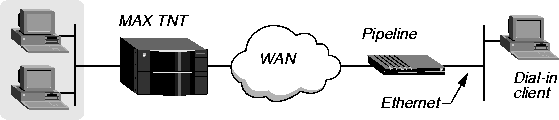
Figure 33. PPP connection
A way for the MAX TNT to decide which route takes highest priority.
Routing Information Protocol (RIP) is a distance-vector protocol, which uses a hop count to select the shortest route to a destination network. Open Shortest Path First (OSPF) is a link-state protocol, which can take into account a variety of link conditions, such as the reliability or speed of the link, when determining the best path to a destination network. Because the metrics used by the two protocols are incompatible, the MAX TNT supports route preferences.
By default, static routes and RIP routes have the same preference, so they compete equally. Internet Control Message Protocol (ICMP) Redirects take precedence over both, and OSPF takes precedence over everything. If a dynamic route's preference is lower than that of the static route, the dynamic route can temporarily hide a static route to the same network. However, dynamic routes age, and if no updates are received, they eventually expire. In that case, the hidden static route reappears in the routing table.
See also dynamic route, hop count, ICMP, metric, OSPF, RIP, route, static route.
The second highest layer in the OSI Reference Model. The Presentation layer is responsible for presenting information in a format understandable to users and their applications. Data conversion, special graphics, compression, and encryption are some of the functions implemented at the Presentation layer. See also OSI Reference Model.
See E1 PRI line, T1 PRI line.
See nailed-up circuit.
An encryption method that uses a single key (that only the sender and receiver know) and a public encryption algorithm. Compare with public-key encryption. See also encryption.
A network particular to an organization, and not connected to a public data network such as the Internet. See also VPN.
A collection of settings that enable you to configure various aspects of an Ascend product. For example, a Connection profile enables you to specify the name, password, and network resources for a dial-in caller. See also Connection profile, pseudo-user profile, subprofile, user profile.
See index.
See PROM.
Programmable Read-Only Memory. PROM is a memory chip on which the system can write data only once. A PROM chip retains its contents across power cycles and system resets. See also EEPROM.
A set of rules governing message exchange over a network or internet. Examples of commonly used protocols are Transmission Control Protocol/Internet Protocol (TCP/IP), Point-To-Point Protocol (PPP), and Internetwork Packet Exchange (IPX). See also internet, IPX, network, PPP, TCP/IP.
See PDU.
Proxy Address Resolution Protocol. Proxy ARP denotes a configuration in which one unit handles address resolution requests for another device. In an ARP request, a device asks a host to provide the host's physical address so that a connection can take place. ARP requests are broadcast only on the local network. If the MAX TNT is the default router on a network and is configured in proxy mode, packets destined for any of the hosts on the network go to the MAX TNT. If a remote host must respond to an ARP request, the MAX TNT can respond on its behalf. See also ARP, proxy mode, router.
A mode in which a Connection profile assigns a local IP address to a remote host. Local hosts see the remote host as though it were on the local network. When calls are made to the remote host, the MAX TNT acts on its behalf, replying to requests and forwarding packets. See also proxy ARP.
A feature that enables the shelf controller to act as a proxy for a host card that goes down. The master shelf controller keeps track of all RADIUS accounting Start records sent by host cards. If it determines that a host card has gone down, the shelf controller sends the accounting server a fail-safe Stop record for each of the card's open sessions.
Figure 34 illustrates the usual chain of events.

Figure 34. Normal RADIUS accounting (no proxy necessary)
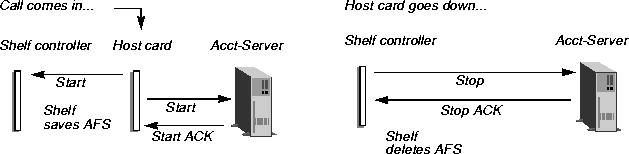
Figure 35. Proxy accounting (host card goes down)
Packet-Switched Data Network. A PSDN is a network in which no connection is required end-to-end. This type of network is very efficient for data transfer, and provides necessary redundancy. Other circuits are automatically available if a line goes down. See also packet switching.
A RADIUS users file entry containing information that the MAX TNT can query. Unlike a RADIUS user profile, it does not exist for the purpose of authenticating a user. Rather, it enables you to specify static route configurations, Frame Relay profile information, and other types of settings. See also user profile, users file.
Public Switched Telephone Network. A PTSN is a public circuit-switched network for telephone users. See also circuit switching.
An encryption method that bases an encryption algorithm on the two halves of a long bit string. Each half of the bit sequence corresponds to a key. One key resides in a public-key library. Only a single party knows the other key. You can use either key to encrypt the data, but both keys are required to decrypt it. The sender can encrypt the data with the receiver's public key, and the receiver can decrypt it with the private key. Or, the sender can use private key to encrypt the message, and the receiver can use the public key to decrypt it. Compare with private-key encryption. See also encryption.
See PSTN.
See PCM.
Permanent Virtual Circuit. A PVC is a path maintained by two stations. The circuit is through the packet-switched network, but stays up all the time, regardless of whether or not data is on the line. Because the circuit is always up, there is no circuit setup time. Compare with SVC. See also packet switching.
To gracefully take a line or modem out of service.
An ITU-T standardized signaling protocol for establishing and clearing 64-kbps switched circuits on E1 digital trunks. Signaling is performed through a combination of A/B bit manipulation in channel 16 of the E1 frame, and inband MF tone generation and detection. The relevant specifications are found in ITU-T recommendations Q.400 to Q.490. R2 signaling is widely implemented in international markets in which ISDN PRI signaling is not yet available. See also E1 line, ITU-T.
Remote Authentication Dial-In User Service. Using RADIUS, end users can have access to secure networks through a centrally managed server. RADIUS provides authentication for a variety of services, such as login, callback, Serial Line Internet Protocol (SLIP), and Point-To-Point Protocol (PPP). It also enables you to set up accounting. You can keep records on the number of packets the MAX TNT transmitted and received, the protocol in use, the user name and IP address of the client, and other system information.
In Figure 36, the RADIUS server performs both authentication and accounting.
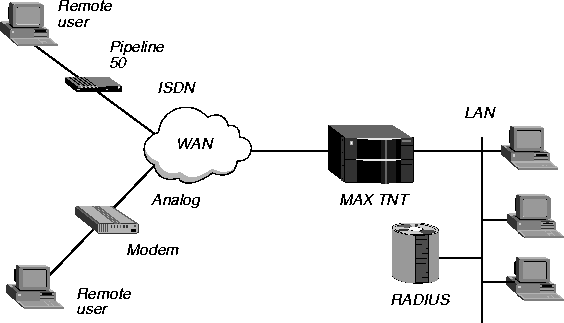
Figure 36. RADIUS authentication and accounting
See accounting.
The RADIUS daemon that runs with a flat ASCII
users file.The daemon that provides users with RADIUS authentication and accounting. Ascend provides a RADIUS daemon that runs with a flat ASCII
users file, and one that runs with a UNIX DBM database. The radiusd daemon runs with a flat file. The radiusd.dbm daemon runs with a UNIX DBM database.The RADIUS daemon that runs with a UNIX DBM database.
The machine on which the RADIUS daemon is running. A single RADIUS server can administer multiple security systems, maintaining profiles for thousands of users. See also RADIUS, radiusd, RADIUS daemon, radiusd.dbm.
Rate Adaptive Asymmetric Digital Subscriber Line card. A RADSL card supports high-bandwidth applications such as remote access, Internet access, intranet access, and telecommuting. Using RADSL allows the MAX TNT to detect the noise level on the line and automatically adjust the data-transfer rate for optimum performance. RADSL supports the following asymmetric transfer rates:
Upstream rate |
Downstream rate |
Distance |
|
544 Kbps
|
640 Kbps
|
17,000 feet (5.18 km)
|
|
1.088 Mbps
|
2.560 Mbps
|
12,000 feet (3.66 km)
|
|
1.088 Mbps
|
7.168 Mbps
|
10,000 feet (3.05 km)
|
See also ADSL, HDSL, IDSL card, SDSL, SDSL card.
Remote Alarm Indicator. An RAI indicates that a device on the DS3 line or DS2 stream is detecting framing-error conditions n the signal it receives. An RAI is also called a Yellow Alarm signal. See also DS3 line.
Random Access Memory. RAM is computer memory that holds data temporarily. See also DRAM, NVRAM.
See RAM.
Reverse Address Resolution Protocol. RARP is a TCP/IP protocol that learns a workstation's hardware address and maps it to an IP address. See also ARP.
A data-transmission method that enables the MAX TNT to send and receive data moving at a rate of 56 Kbps over a 64-Kbps channel. For incoming calls, the MAX TNT automatically adapts the data received at 56 Kbps to the 64-Kbps channel. For outgoing calls, the MAX TNT sets the data rate to either 64 Kbps or 56 Kbps.
For example, suppose a network consists of five switches, one of which uses a 56-Kbps line. The MAX TNT sends data at 56 Kbps over the 64-Kbps line that connects the switch to the network. In doing so, the router drops one of the 8 bits of data and sends only 7 bits at a time. V.120 is a rate-adaption standard. See also V.120.
See RADSL card.
See 802.3.
Raw Transmission Control Protocol. Raw TCP is a method of supporting encapsulation performed by an application that runs on top of TCP. Raw TCP must be understood by both the login host and the caller. As soon as the connection is authenticated, the MAX TNT establishes a TCP connection to the host specified in the Connection profile or RADIUS user profile.
In a TCP dial-in session that does not require V.120 processing, the MAX TNT can buffer and transmit data as TCP packets, rather than as a continuous data stream. In addition, unless V.120 processing is required, raw TCP WAN data goes directly to the HDLC interface, rather than to the terminal-server subsystem. If V.120 processing is required, the terminal server processes the call.
Raw TCP is also known as TCP-Clear. See also HDLC card, TCP, V.120.
See Raw TCP.
Regional Bell Operating Company. An RBOC is one of seven companies created after the breakup of AT&T. The RBOCs are Ameritech, Bell Atlantic, Bell South, NYNEX, Pacific Telesis, Southwestern Bell, and U.S. West.
Reliable Data Protocol. RDP provides a reliable data transport service for packet-based applications. It is simple to implement, and works efficiently in environments that have long transmission delays and non-sequential delivery of message segments.
See ROM.
A signal indicating that an out-of-frame condition has lasted for more than 2.23 msec on the DS3 line, or more than 9.9 msec on the DS2 stream. See also DS3 line, out-of-frame condition.
A method of safeguarding against line and equipment failure during a transmission. Each method for transmitting signals has inherent error rates, and all physical media is subject to damage. In the event of hardware failure, a redundant line or unit can take over at any time. You should always have a redundant (backup) module for multiplexers and other critical equipment.
An interface that enables the router to handle packets whose IP address matches an unused IP address in a summarized address pool. The reject interface has an IP address of 127.0.0.2. When you specify this address as the router to the destination pool network, the MAX TNT rejects packets to an invalid host on that network, appending an ICMP Host Unreachable message. See also pool summary.
See RDP.
See RAI.
See RADIUS.
A unit that resides across the WAN.
The process of allowing branch offices, telecommuters, and traveling computer users to access the corporate LAN backbone over digital or analog lines. The lines can be switched or nailed up. See also analog line, digital line, nailed-up line, switched line.
A MAX TNT management feature that uses bandwidth between sites over a management subchannel. Any Ascend unit can control, configure, and obtain statistical and diagnostic information about any other Ascend unit. Multilevel security assures that unauthorized personnel do not have access to remote-management functions.
A network to which the MAX TNT connects over the WAN.
See RPM.
See RPC.
A user profile configured in RADIUS, TACACS, or TACACS+, as opposed to a Connection profile configured on the Ascend unit. See also user profile.
A user at a device not connected directly to the Ascend unit and not residing on the local Ethernet.
A strategy for gaining illegal access to a system. During a replay attack, an unauthorized user records valid authentication information exchanged between systems, and then replays it later to gain entry. Token-card authentication protects your system against replay attacks. Because the token is a one-time-only password, replay is impossible. See also token-card authentication.
See RFC.
See RTS.
See RSVP.
See RARP.
Request for Comments. RFC denotes the document series, begun in 1969, that describes the Internet suite of protocols and related experiments. Not all RFCs describe Internet standards, but all Internet standards are written up as RFCs. The RFC series of documents is unusual in that the proposed protocols are distributed by the Internet research and development community, acting on its own behalf. The protocols do not go through the formal review and standardization process promoted by organizations such as ANSI. A complete list of RFCs resides at http://www.internic.net/rfc/.
Ring Indicate. RI is a signal that indicates that a call is coming into a unit.
See RI.
Routing Information Protocol. RIP is a distance-vector protocol found in both the NetWare and TCP/IP protocol suites. The protocol keeps a database of routing information that it gathers from periodic broadcasts by each router on a network.
IPX routers broadcast RIP updates periodically and when a WAN connection is established. The MAX TNT receives IPX RIP broadcasts from a remote device, adds 1 to the hop count of each advertised route, updates its own RIP table, and broadcasts updated RIP packets on connected networks in a split-horizon fashion.
The MAX TNT follows standard IPX RIP behavior for routers when connecting to non-Ascend units. However, when it connects to another Ascend unit configured for IPX routing, both ends of the connection immediately exchange their entire RIP tables. In addition, the MAX TNT maintains those RIP entries as static until the unit is reset or power cycled.
The MAX TNT recognizes network number -2 (0xFFFFFFFE) as the IPX RIP default route. When it receives a packet for an unknown destination, the MAX TNT forwards the packet to the IPX router advertising the default route. If more than one IPX router is advertising the default route, the unit makes a routing decision based on the hop and tick count. For example, if the MAX TNT receives an IPX packet destined for network 77777777 and it does not have a RIP table entry for that destination, the MAX TNT forwards the packet towards network number FFFFFFFE, if available, instead of simply dropping the packet.
See also default route, distance-vector metric, hop, IPX, IPX router, router, routing, split horizon, TCP/IP, tick.
An Application-layer, remote-login service provided by Berkeley UNIX. On the MAX TNT, Rlogin is available only from an asynchronous dialup session to the terminal server. See also Application layer.
Read-Only Memory. ROM is computer memory whose contents can be read and executed, but not modified. See also EEPROM, PROM.
A type of hunt group in which the incoming call hunts on a rotating basis for an available channel to ring and answer the call. See also hunt group.
See Shelf-Select rotary switch.
The path that data takes from its source network to its destination network. See also IP route, IPX route.
See IP route cache.
A device that determines a path from a host on one network to a host on another. The networks may be in close proximity, or may be separated by long distances. A router has access to the three lowest OSI layers, and generally operates at the Network layer. To route a packet, a router uses the logical address specified as the packet's destination field, and determines the next router (if any) to which the packet must travel to reach its destination. All routers share information about the current topology and state of the network, maintaining routing tables that reflect the latest information. See also IP router.
An Ascend Tunnel Management Protocol (ATMP) configuration in which the home agent's routing module forwards packets it receives from the foreign agent onto the local network. The network can be the home network, or it can support another router that can connect to the home network. In either case, packet delivery relies on a routing mechanism, such as a static or dynamic route, and not on a WAN connection. Compare with gateway mode. See also ATMP, dynamic route, foreign agent, home agent, home network, static route.
A type of filter containing rules for the action to take on routes in Routing Information Protocol (RIP) update packets. When you apply a route filter to an IP interface, the MAX TNT monitors RIP packets on the interface and takes one of the following actions when a route matches the filter rules:
A method of determining how to forward a data packet to the proper destination. See also IP routing, IPX routing, OSPF, RIP, route, router.
See RIP.
See IP routing table.
Remote Procedure Call. An RPC is a method in which a program on one device can transparently use a procedure on another device. RPCs are often used in client-server architectures.
Remote Port Module. An RPM is an Ascend unit that enables you to extend data, signaling, and control ports to local applications over Unshielded Twisted Pair (UTP) cable. See also UTP cable.
An EIA standard that specifies various electrical and mechanical characteristics for interfaces between Data Terminal Equipment (DTE) and Data Circuit-terminating Equipment (DCE) devices. The standard applies to both synchronous and asynchronous binary data transmission at rates below 64 Kbps. RS-232 is also known as EIA/TIA-232. Compare with RS-422, RS-423. See also asynchronous transmission, DCE, DTE, synchronous transmission.
A standard EIA interface for connecting serial devices. Along with RS-423, RS-422 replaces the RS-232 standard. RS-422 supports higher data rates than RS-232, and offers greater protection against electrical interference. All Apple Macintosh computers contain an RS-422 port that you can use for RS-232 communication. RS-422 supports multipoint connections, while RS-423 does not. RS-422 and RS-423 are often referred to collectively as EIA-530. Compare with RS-232, RS-423. See also EIA, multipoint link.
A standard EIA interface for connecting serial devices. Along with RS-422, RS-423 replaces the RS-232 standard. RS-423 supports higher data rates than RS-232, and offers greater protection against electrical interference. All Apple Macintosh computers contain an RS-423 port that you can use for RS-232 communication. Unlike RS-422, RS-423 supports only point-to-point connections. RS-422 and RS-423 are often referred to collectively as EIA-530. Compare with RS-232, RS-422. See also EIA, point-to-point link.
A standard EIA Physical-layer interface. RS-449 is a a faster version of RS-232, and allows longer cable extension. RS-449 can run at speeds of up to 2 Mbps, and is also known as EIA/TIA-449. Compare with RS-232.
Reservation Protocol. RSVP enables a router to reserve bandwidth for time-sensitive data transmissions, resulting in smooth reception of voice and video data. A client can use RSVP to request that a router set aside a certain amount of bandwidth to handle the incoming call. If sufficient bandwidth does not exist, the request enters a queue and remains there until the appropriate amount of bandwidth becomes available.
Request To Send. RTS is a signal that a transmitter sends to a receiver in order to indicate that it wants to begin sending data. If the receiver is ready for the transmission, it responds with a Clear To Send (CTS) signal. See also CTS.
See Enigma Logic SafeWord server.
A form of token-card authentication in which RADIUS forwards a connection request to an Enigma Logic Safeword server, a type of authentication server. The SafeWord server sends an Access-Challenge packet back through the RADIUS server and the MAX TNT to the user dialing in. The user sees the challenge message, obtains the current password from his or her token card, and enters the current password (called a token).
The token travels back through the MAX TNT and the RADIUS server to the SafeWord server. The SafeWord server sends a response to the RADIUS server, specifying whether the user has entered the proper user name and token. If the user enters an incorrect token, the SafeWord server returns another challenge, and the user can again attempt to enter the correct token. The server sends up to three challenges. After three incorrect entries, the MAX TNT terminates the call.
See also authentication, authentication server, RADIUS server, SafeWord token, token-card authentication, token-card server.
A randomly generated access code that a user obtains from a token card when using a SafeWord authentication server. See also SafeWord authentication.
Secure Access Manager. SAM gives you a high degree of centralized control over the security functions of an entire network. Through this Windows-based application, you can configure Secure Access Firewall(s) offline, and download the configuration to remote locations. See also Secure Access Firewall.
Service Access Point. A SAP is a defined location through which a procedure at one OSI layer can provide services to the next layer above it. Each SAP has a unique address in hexadecimal format. See also DSAP, OSI Reference Model, SSAP.
Service Advertising Protocol. SAP is a NetWare protocol that operates at the Transport layer and enables servers to inform other devices about the services they have available. Each server advertises its services using a SAP packet. Each router on the network retrieves the SAP packets and builds a database of all the servers it knows about. The router then broadcasts this information to other routers, either at a set interval or whenever the database changes.
The MAX TNT follows standard SAP behavior for routers when connecting to non-Ascend units across the WAN. However, when it connects to another Ascend unit configured for IPX routing, both ends of the connection exchange their entire SAP tables, so all remote services are immediately added to the MAX TNT unit's SAP table.
When a NetWare client sends a SAP request to locate a service, the MAX TNT consults its SAP table and replies with its own hardware address and the internal network address of the requested server. This behavior is analogous to the use of proxy ARP in an IP environment. The client can then transmit packets whose destination address is the internal address of the server. When the MAX TNT receives those packets, it consults its Routing Information Protocol (RIP) table. If it finds an entry for that destination address, it brings up the connection (unless it is already up) and forwards the packet. See also IPX router, IPX server, proxy ARP, RIP.
Service Advertising Protocol filter. A filter that determines which SAP advertisements the MAX TNT forwards or drops. Each IPX-SAP-Filter profile contains up to eight input filters and output filters, numbered from 1 to 8, which are defined individually and applied in order to the packet stream.
The router examines incoming and outgoing SAP packets to see whether certain fields in the packet match the filter. The MAX TNT applies input filters to all SAP packets it receives. Input filters screen advertised services and exclude them from (or include them in) the MAX TNT service table. The MAX TNT applies output filters to SAP response packets it transmits. If it receives a SAP request packet, the MAX TNT applies output filters before transmitting the SAP response, and excludes services from (or includes them in) the response packet.
A SAP filter enables you to control the size of resident SAP tables and reduce bandwidth usage. You can also use a SAP filter to restrict a user's view of services on the network. By turning off IPX SAP, you can prevent the MAX TNT from sending its SAP table or from receiving a remote site's SAP table.
See also SAP.
Source Demand Routing Protocol. SDRP supports source-initiated selection of interdomain routes, working along with the intermediate node selection provided by Border Gateway Protocol (BGP) and Inter-Domain Routing Protocol (IDRP). See also BGP, IDRP.
Symmetric Digital Subscriber Line. SDSL is a technology transmits 1.544 Mbps each way over a single copper twisted-pair wire at a distance of up to 12,000 feet. Compare with ADSL, HDSL, IDSL card, RADSL card. See also SDSL card.
Symmetric Digital Subscriber Line card. An SDSL card supports high-bandwidth applications such as remote access, Internet access, internet access, and telecommuting. It implements symmetric data transfer rates of 768 Kbps for a distance of up to 12,000 feet (3.7 km) using a single pair of copper wires.
SDSL supports Frame Relay and Point-to-Point protocol (PPP). You configure Frame Relay or PPP connections on an SDSL connection in the same way you configure them on a T1 or serial WAN interface. By using PPP protocols in conjunction with Password Authentication Protocol (PAP) or Challenge Handshake Authentication Protocol (CHAP), you can use your existing authentication methods, such as RADIUS, to grant access to SDSL users.
SDSL lines are always physically connected, but can be logically disconnected and reconnected. The MAX TNT supports both single-port and two-port SDSL. Two-port SDSL enables two combined 7840-Kbps links to transfer a maximum of 1.518 Mbps. Multilink Protocol Plus (MP+) is required to manage transmissions on the peer ports.
See also CHAP, Frame Relay, internet, MP+, PAP, PPP, RADIUS, SDSL, serial WAN port, T1 line.
An Ascend software option that stops intruders from breaking and entering into your network. A firewall is similar to a filter, but is more complex, dynamically changing in response to the characteristics of the packets that pass through it. The firewall affects which packets are allowed to reach the network, and which packets can leave the network for another interface. Typically, you can design a firewall to flag a packet with specific bit patterns, and put rules into action that cause other rules to be created. For a firewall to take effect, you must apply it to a LAN or WAN interface. See also filter persistence, SAM.
See SAM.
A proprietary brand of token card used with a Security Dynamics ACE/Server. The server generates a code based on a user's ID, a password, and specific information encoded in the card. When the user attempts to log into a secure network, the token-card server requests a code generated within the previous 60 seconds. The server interprets the code. If it is genuine, the server grants access to the user. See also ACE authentication, ACE token, authentication, authentication server, Security Dynamics ACE/Server, token card, token-card authentication, token-card server.
See token card.
See token-card authentication.
See token-card server.
A type of authentication server that performs token-card authentication. See also ACE authentication, ACE token, authentication, authentication server, Secure ID, token card, token-card authentication, token-card server.
An IPX or AppleTalk router from which other routers learn their network configurations. Compare with nonseed router. See also AppleTalk routing, IPX router.
Communication through the serial port of a device. For Windows 3.1, the maximum speed of the serial port is 19,200. For Windows 95, the serial port limit is 921,600. These limitations are subject to change with the development of a faster serial bus. See also serial port, serial transmission.
A link between the serial ports of two devices. See also serial communication, serial port, serial transmission.
A device (such as a videoconferencing codec) that is connected to a serial WAN port communicating over a point-to-point link. To a serial host, the MAX TNT appears to be a cable or Data Circuit-terminating Equipment (DCE). See also codec, DCE, point-to-point link, serial WAN port.
See SLIP.
A port that transmits and receives asynchronous or synchronous serial data. See also asynchronous transmission, serial transmission, synchronous transmission.
A form of data transmission in which only one line carries all eight bits of a byte. In serial transmission, one bit follows another (as opposed to parallel transmission, in which the bits travel simultaneously, each on a different wire). Serial transmission can be either synchronous or asynchronous. Synchronous communication requires additional lines for transmitting handshake or timing signals. In asynchronous communication, the data itself contains synchronization information, so neither handshake nor clock signals are necessary. See also asynchronous transmission, synchronous transmission.
See SWAN card.
A port that provides a V.35/RS-449/X.21 WAN interface, typically used to connect the MAX TNT to a Frame Relay switch.The clock speed received from the link determines the serial WAN data rate. The maximum acceptable clock is 8 Mbps. The clock speed at the serial WAN port has no effect on the bandwidth of other WAN interfaces in the MAX TNT. See also serial transmission, SWAN card.
A MAX TNT card that supports V.34bis or K56flex-compatible digital modems. Each digital modem provides analog and cellular connections at rates of up to 56 Kbps. You can install a maximum of six Series56 Digital Modem cards on a MAX TNT. Each card occupies two slots. When you install the card, a remote user can dial into the MAX TNT over a T1 line. See also analog data, digital modem, Digital Modem card, E1 PRI line, K56flex, MAX TNT, T1 line, T3 line.
A device or program that provides services to hosts on a network.
See SAP.
See SAP.
See SPID.
The state a connection reaches when two parties can communicate with each other.
A unique ID that denotes a particular MAX TNT session. The MAX TNT can pass a session ID to SNMP, RADIUS, or other external entities. See also session, session ID base.
The base number for calculating a session ID. If the value of the session ID base is nonzero, the MAX TNT uses it as the initial base for calculating session IDs after a system reset. The system increments the ID for each subsequent session by 1. If the session ID base is zero, the MAX TNT sets the initial base for session IDs to the absolute clock. For example, if the clock is 0x11cf4959, the subsequent session IDs uses 0x11cf4959 as a base. However, if the clock changes and the system reboots or clears NVRAM, session IDs may be duplicated. See also session, session ID.
The third highest layer in the OSI Reference Model. The Session layer synchronizes the data in a network connection, maintains the link until the transmission is complete, handles security, and makes sure that the data arrives in the proper sequence. Gateway communications are implemented at the Session layer. Examples of Session-layer protocols are AppleTalk Data Stream Protocol (ADSP), NetBEUI (an extension of NetBIOS), NetBIOS, and Printer Access Protocol (PAP). See also OSI Reference Model.
The portion of a MAX TNT that supports up to 720 simultaneous digital-modem, ISDN, or 56/64-Kbps Frame Relay sessions. A single MAX TNT shelf can also terminate up to 150 nailed-up T1 Frame Relay lines, and supports up to 16 cards with redundant, load-balancing power supplies. You can configure a MAX TNT with up to three shelves. See also digital modem, Frame Relay, ISDN, T1 line, unchannelized service.
The device on the MAX TNT that controls data transmission and call routing for an individual shelf. Residing in slot 17, the shelf controller contains Uplink and Downlink ports for intershelf communication, an Unshielded Twisted Pair (UTP) port, a serial port, two PCMCIA slots, a DRAM upgrade slot, and a Shelf-Select rotary switch. See also DRAM upgrade slot, master shelf controller, PCMCIA slot, serial port, Shelf-Select rotary switch, slave shelf controller, UTP port.
A switch on the shelf-controller backpanel. The system uses the Shelf-Select rotary switch for a MAX TNT multishelf configuration. Each shelf in a multishelf system must have its rotary switch set to a unique number. See also multishelf system, shelf controller.
See STP cable.
A protocol architecture that specifies a series of Signaling Points (SPs) and Signaling Transfer Points (STPs) connected on a network. The SPs are hosts from which signaling messages originate and terminate. The STPs are packet switches that perform message routing between adjacent SPs or STPS. The Network Services Part (NSP) of the Signaling System 7 provides reliable message transfer, and corresponds to the lower three layers of the OSI model. The NSP consists of a Message Transfer Part (MTP) and a Signalling Connection Control Part (SCCP). See also OSI Reference Model.
A mutually agreed-upon way to maintain synchronization and transfer data effectively between endpoints. The sending device and the receiving device must send signals in order to synchronize their clocks and determine where one block of data ends and the next begins. Inband signaling, ISDN D-channel signaling, and Non-Facility Associated Signaling (NFAS) are all examples of signaling types. See also inband signaling, ISDN D-channel signaling, NFAS.
See SMTP.
See SNMP.
See S/T interface.
A shelf controller that simply forwards messages between slot cards and the master shelf controller. See also master shelf controller, shelf controller.
Serial Line Internet Protocol. SLIP enables your computer to send and receive IP packets over a serial link. The MAX TNT does not support a direct SLIP dial-in, because SLIP does not support authentication. However, if SLIP is enabled in the terminal server, a user can initiate a SLIP session, and then run an application such as File Transfer Protocol (FTP). To begin a SLIP session, the user can log into the terminal server in terminal mode and use the SLIP command. Or, you can include the SLIP command in an expect-send script. Compare with CSLIP. See also expect-send script, FTP, terminal mode, terminal server.
On the backplane of a MAX TNT, the connector that provides the physical and electrical connection between a card and the MAX TNT unit's base resources.
A card you install on the MAX TNT in order to enhance its functionality. For example, you can install a Digital Modem card to provide digital modem access.
Compression in which the slot ID does not appear in any VJ-compressed packet but the first packet in the data stream. When you turn on VJ compression, the MAX TNT removes the TCP/IP header, and associates a TCP/IP packet with a connection by giving it a slot ID. The first packet coming into a connection must have a slot ID, but succeeding packets need not have one. By default, the MAX TNT uses slot compression: if the packet does not have a slot ID, the MAX TNT associates it with the last-used slot ID. See also VJ compression.
Switched Multimegabit Data Service. SMDS is a packet-based service that enables the creation of high-speed data networks with rates of up to 45 Mbps.
Simple Mail Transfer Protocol. In the TCP/IP protocol suite, SMTP is an Application-layer protocol that uses the TCP Transport-layer protocol to send and receive electronic mail. See also TCP/IP.
SubNetwork Access Protocol. SNAP is a protocol specification for the format of the Media Access Control (MAC) header of an IPX frame. SNAP includes the IEEE 802.3 protocol format plus additional information in the MAC header. Compare with 802.2, 802.3, Ethernet II. See also IPX frame, MAC.
Simple Network Management Protocol. SNMP is a standard way for computers to share networking information.
In SNMP, two types of communicating devices exist: agents and managers. An agent provides networking information to a manager application running on another computer. The agent can be polled by the manager, and can also use a message called a traps-PDU to send unsolicited information to the manager when an unusual event occurs. The MAX TNT is an example of an SNMP agent. The agents and managers share a database of information, called the Management Information Base (MIB).
The MAX TNT supports SNMP MIB II, T1 MIB, and Ascend Enterprise MIBs. A manager that uses the Ascend Enterprise MIB can query the MAX TNT, set parameters, sound alarms when certain conditions appear, and perform other administrative tasks. You can therefore manage the MAX TNT from a central SNMP manager, such as SunNet Manage or HP Open View.
SNMP security uses the community name that the manager sends (with each polling request) and that the agent sends (with each traps-PDU). Ascend supports two community names: one with read-only access, and the other with read/write access to the MIB.
A TCP/IP interface that facilitates a two-way link between systems, enabling applications to run over a connectionless network. A socket is defined by two addresses: the IP address of the host computer, and the port address of the application or process running on the host. See also IP address, port, TCP/IP.
A unique value assigned to a socket in a network. See also socket.
An IP address that is not associated with a physical interface. A soft interface is just like any other interface on the MAX TNT, except that it is never down. In general, the MAX TNT uses the soft IP address for incoming packets. You can also specify the soft interface address as the system IP address, in which case it becomes the source address for the traffic generated by the MAX TNT. Routing protocols advertise the address as a host route with a mask of 32, using the loopback interface.
Other hosts on the network must be able to reach the address you assign as the soft interface address, so you must either enable routing protocols (RIP, OSPF) or configure static routes in routers one hop away from the MAX TNT. To verify that other hosts in your network have a route to the soft address, use Ping and Traceroute from the other hosts to the MAX TNT.
Compare with system address. See also IP address, OSPF, RIP, static IP route.
See compression.
See SDRP.
See SSAP.
Service Profile Identifier. A SPID is a number that the telephone company uses at the Central Office (CO) switch to identify services on your ISDN line. Each SPID is derived from a telephone number.
An IPX mechanism for preventing circular routes and reducing network traffic. The simple split-horizon scheme omits routes learned from one neighbor in updates sent to that neighbor. A split horizon with poison reverse policy includes such routes in updates, but sets each metric to infinity.
Source Service Access Point. An SSAP is the Service Access Point (SAP) address at which at a Network-layer procedure requests services from the Logical Link Control (LLC) layer. See also DSAP, SAP.
See Stac LZS compression.
On the MAX TNT, a compression option that specifies an Ascend-modified version of draft 0 of the CCP (Compression Control Protocol). The Stac option is an Ascend variant of the Stac LZS compression method. It was implemented before Stac LZS was standardized. Compare with Stac LZS compression.
On the MAX TNT, a compression option that indicates the method specified by draft 9 of the Stac LZS compression protocol. Compare with Stac compression. See also Stac LZS compression.
Stac Lempel-Ziv standard compression. Developed by Stac Incorporated, Stac LZS compression can triple data rates. Compare with Stac compression. See also Stac-9 compression.
A group of MAX TNT units that act as a single, logical unit with a single stack name. A stack allows incoming Multilink Protocol (MP) or Multilink Protocol Plus (MP+) calls to span multiple MAX TNT units on a single LAN. There is no master unit in a stack. A MAX TNT can become a member of a stack or leave a stack at any time, and there is no requirement to join a stack. MAX TNT units in a stack find each other using an Ethernet multicast packet. Because multicast packets are unlikely to cross a router, all members of a stack must reside on the same physical LAN. See also MP, MP+, multicast.
In asynchronous transmission, a bit that indicates the beginning of a new character. It is always 0 (zero). Compare with parity bit, stop bit. See also asynchronous transmission.
A RADIUS-accounting or call-logging record that contains information about the beginning of a session with the MAX TNT. See also Start session.
An event denoting the beginning of a session with the MAX TNT. Information about a Start session event appears in a RADIUS-accounting or call-logging Start record.
A path that specifies a destination IP network and the gateway (next-hop router) to get to that network. Each Connection profile, IP-Interface profile, RADIUS user profile, and RADIUS pseudo-user profile that specifies an explicit IP address defines a static route to a remote or local IP network.
For example, if a Connection profile specifies the destination address of a host on a remote subnet, but the packets must be routed through an intermediary device to reach that host (and RIP or OSPF is not enabled), you must configure a static route specifying the intermediary device as the gateway. Figure 37 shows an example.
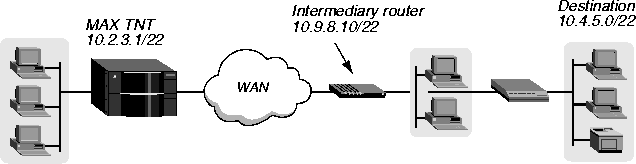
Figure 37. Static route to a remote subnet
A route (configured in either an IPX-Interface profile or in a RADIUS pseudo-user profile) that contains all the information necessary to reach one IPX server on a remote network. The MAX TNT adds the static routes upon initialization. When the MAX TNT receives an outgoing packet for a server, it finds the corresponding profile and dials the connection. You must manually update static routes whenever the administrator at the remote end removes the specified server or updates its address. You do not need to create IPX routes to servers that reside on the local Ethernet network. See also IPX server, pseudo-user profile.
A password specified in a Connection profile or RADIUS user profile. The user must enter the password to gain access to the MAX TNT. See also Connection profile, user profile.
See static IP route, static IPX route.
See host.
A window in the MAX TNT interface that displays system status information. The default status window contains three window areas-a large portion on the left, and a portion on the right consisting of top and bottom windows. The left side displays WAN connection and session status. The right-hand windows can display general status information, data on Ethernet activity, the contents of the log buffer, and line statistics.
n. The electrical interface between a network terminator (NT1) and one or more ISDN communications devices without their own NT1s. See also NT1.
adj. Describes an ISDN communications device that connects to an external network terminator (NT1). See also NT1.
In asynchronous transmission, a bit that marks the end of the character. It appears after the parity bit, if one is in use. Compare with parity bit, start bit. See also asynchronous transmission.
A RADIUS-accounting or call-logging record that contains information about the end of a session with the MAX TNT. See also Stop session.
An event denoting the end of a session with the MAX TNT. Information about the Stop session event appears in a RADIUS-accounting or call-logging Stop record.
Shielded Twisted Pair cable. STP cable consists of two wires twisted two or more times per inch in order to help cancel out noise. The entire cable has a protective covering. STP cable is typically used in ARCnet and Token Ring networks. See also ARCnet, Token Ring
A cable with wires that have terminating ends with the same wire assignments. Compare with crossover cable.
An Open Shortest Path First (OSPF) area in which all external routes are summarized by a default route. To reduce the cost of routing, OSPF supports stub areas. A stub area allows no Type-5 LSAs to be propagated in the area. Instead, it depends on default routing to external destinations. Compare with normal area, NSSA. See also area, Open Shortest Path First.
See IP subnet.
An IP feature in which a group of bits identifies a subnet. To specify a subnet mask, the MAX TNT appends to the IP address a modifier that specifies the total number of network bits in the address.
For example, in the address 198.5.248.40/29, the /29 specification indicates that 29 bits of the address specify the network. The three remaining bits specify unique hosts. With three bits used to specify hosts on a 29-bit subnet, eight different bit-combinations are possible:
000-Reserved for the network (base address)
Standard and Ascend subnet formats for a class C network number are:
198.5.248.120/29The Ethernet attached to that router has the following address range:
198.5.248.120-198.5.248.127A host route is a special-case IP address with a subnet mask of /32. For example:
198.5.248.40/32Host routes are required for a dial-in host.
See also host number, host route, IP, IP address, IP subnet, IP network number.
See SNAP.
A set of parameters nested below a top-level profile in the MAX TNT Command-Line Interface (CLI). See also CLI, profile.
A nailed-up service available only in Japan. Subscribers receive two ISDN B channels combined into a single 128K pipe.
Switched Virtual Circuit. An SVC is a path over a packet-switched network. It appears to be a dedicated circuit, but the connection stays up only as long as needed. Compare with PVC.
Serial WAN card. A SWAN card in the MAX TNT provides four V.35 serial WAN ports, each of which supports one nailed-up Frame Relay connection. Flow control is always handled by the Clear To Send (CTS) signal. When the system detects that a SWAN card is installed, it creates a default SWAN line profile for each of the lines on the card. By default, the lines are not enabled. A separate SWAN-Stat profile displays the status of each SWAN line. See also CTS, inband signaling, serial WAN port.
IP with Encryption. SWIPE is a Network-layer security protocol that works by adding a cryptographic authenticator to each packet, and encrypting the data.
A device that connects the calling party to the answering party.
A data service consisting of a single 56-Kbps channel. The Switched-56 data service is available over any type of line. Because Switched-56 was the first available data service, both the service itself and the lines that accessed it were called Switched-56. However, any type of line can now access Switched-56 data service, and there are other new services in addition to Switched-56.
A line that provides a single 56-Kbps data channel with inband signaling. See also inband signaling.
A data service consisting of a single 64-Kbps channel. The Switched-64 data service is available over T1 PRI and ISDN BRI lines only. See also ISDN BRI line, T1 PRI line.
A data service consisting of a single 384-Kbps circuit, called an H0 channel. The H0 channel is comprised of 6 B channels. The Switched-384 data service is available over T1 PRI lines only. Switched-384 is also known as the H0 data service. See also B channel, T1 PRI line.
A data service consisting of a single 1536-Kbps circuit, called an H11 channel. The H11 channel is comprised of all 24 channels on the line. You must use two T1 PRI lines to access Switched-1536. One line carries the user data, and the other line contains the D channel. Non-Facility Associated Signaling (NFAS) is required for the Switched-1536 data service because the D channel must be on a separate line. The Switched-1536 data service is available over T1 PRI lines only. Switched-1536 is also known as the H11 data service. See also D channel, NFAS, T1 PRI line.
A channel that provides a temporary connection for the exchange of data. The channel is cleared when the call ends. Compare with nailed-up channel.
A temporary connection between endpoints, established for the duration of a call, over which two parties exchange data. The circuit is disconnected when the call ends. Compare with nailed-up circuit.
A line consisting of channels in use only for the duration of the connection. Compare with nailed-up line.
See SMDS.
See MultiRate.
A name that denotes an IP address. A symbolic name consists of a user name and a domain name in the format username@domain_name. The user name corresponds to the host number in the IP address. The domain name corresponds to the network number in the IP address. A symbolic name might be steve@abc.com or joanne@xyz.edu. See also IP address.
See SDSL card.
A method of ensuring that the receiving end can recognize characters in the order in which the transmitting end sent them, and can know where one character ends and the next begins. Without synchronization, the receiving end would perceive data simply as a series of binary digits with no relation to one another.
A transmission mode in which the data moves in large blocks, called messages or frames. A synchronous WAN link uses High-level Data Link Control (HDLC) encoding and connects to a router for a network-to-network link. The MAX TNT routes a synchronous transmission as a digital call to an HDLC channel, and then to the router software. Each synchronous call uses Point-To-Point Protocol (PPP), Multilink Protocol (MP), Multilink Protocol Plus (MP+), or Frame Relay encapsulation.
In a synchronous transmission, both the sending device and the receiving device must maintain synchronization in order to determine where one block of data ends and the next begins. Each side can transmit a separate synchronizing signal, called a clock. Or, each frame or message can contain synchronization information.
In the latter method, each block of data starts with one or more control characters, usually eight bytes long, called a SYNC. The receiver interprets the SYNC as a signal that it can start accepting data. Synchronous transmission can be up to 20 percent faster than asynchronous transmission.
See also Frame Relay, HDLC, MP, MP+, PPP, synchronization.
A facility that sends system status messages to a host computer, known as the Syslog host. The Syslog host saves the system status messages in a Syslog file. For detailed information about the Syslog daemon, see the UNIX man pages on
logger(1), syslog(3), syslog.conf(5), and syslogd(8). The Syslog function requires User Datagram Protocol (UDP) port 514. The station to which the MAX TNT sends system logs.
A message that is written to a
syslog file on the Syslog host. The types of Syslog messages that can appear are:
The message fields appear in the following order:
protocol local direction remote length frag log tagThe message portion of a SAM-generated message consists of the following elements:
system address
You can set a system address to specify the source address for packets the MAX TNT originates. Specifying a system address forces the MAX TNT to use an IP address assigned to an Ethernet interface on a slot card as the source address, rather than the shelf-controller address. In addition, some tunneling protocols, such as Ascend Tunnel Management Protocol (ATMP), require that you specify a system address.
See also IP address, RADIUS, RADIUS server.
A form of IP routing in which the entire unit has a single IP address. For systems that have a single backbone connection, system-based routing is the simplest way to configure the MAX TNT. Compare with interface-based routing.
See status window.
A MAX TNT card that provides eight ports, each of which can be connected to a T1 PRI line, a fractional T1 line, or an unchannelized T1 line. When the MAX TNT detects a T1 card, it creates a default T1 line profile for each of the eight lines on the card. See also fractional T1 line, T1 channel, T1 line, T1 PRI line, unchannelized service.
One of 24 channels on a T1 line. See also fractional T1 line, T1 card, T1 line, T1 PRI line, unchannelized service.
A line that supports 24 64-Kbps channels, each of which can transmit and receive data or digitized voice. The line uses framing and signaling to achieve synchronous and reliable transmission. The most common configurations for T1 lines are ISDN Primary Rate Interface (T1 PRI) and unchannelized T1, including fractional T1. See also fractional T1 line, T1 card, T1 channel, T1 PRI line, unchannelized service.
T1 Primary Rate Interface line. A T1 PRI line has a total bandwidth of 1.544 Mbps. It uses 23 B channels for user data, and one 64-Kbps D channel for ISDN D-channel signaling, The B channels can be all switched, all nailed up, or a combination of switched and nailed up. The T1 PRI line is a standard in North America, Japan, and Korea. You can connect this type of line to standard voice, Switched-56, Switched-64, Switched-384, Switched-1536, and MultiRate data services. Compare with E1 PRI line, ISDN BRI line, unchannelized service. See also B channel, D channel, MultiRate, nailed-up channel, PCM, Switched-56, Switched-64, Switched-384, Switched-1536, T1 card, T1 channel, T1 line.
See T1 PRI line.
A MAX TNT communications circuit composed of seven DS2s, each of which consists of four DS1s, each of which consists of 24 DS0s, for a total of 720 DS0 channels. On the T3 card, DS2 #1 includes DS1 lines 1-4, DS2 #2 includes DS1 lines 5-8, and so on. Each DS1 is similar to a T1 line, except that on the T3 card, a DS1 only functions if the DS2 and DS3 that contain it are up and in frame. You can think of the T3 card as a collection of 28 T1 lines, because the card provides 28 independently configurable DS1 lines. See also DS0 channel, DS1 channel, DS2 channel, DS3 line.
A digital transmission link consisting of 28 T1 lines with a total bandwidth of 44.736 Mbps. See also T1 line, T3 card.
Terminal Adapter. A TA is a protocol converter that adapts non-ISDN equipment (such as a phone, fax, or modem), and enables each device to work over an ISDN connection. A TA has two functions. First, it must change the format of transmitted data to match the V.120 standard for asynchronous transfer over a B channel. Second, it must provide a way of setting up and clearing calls, usually by means of Hayes AT commands. A TA is to an ISDN line what a modem is to an analog telephone line. However, some of the D-channel information does not pass through the TA, so non-ISDN equipment cannot take full advantage of ISDN facilities, such as Calling-Line ID (CLID). See also ISDN, V.120.
Terminal Access Concentrator Access Control Server. TACACS is a very simple query/response protocol that enables the MAX TNT to check a user's password in order to grant or prevent access. A TACACS server supports only the basic password exchanges that Password Authentication Protocol (PAP) uses. It does not support Challenge Handshake Authentication Protocol (CHAP). See also CHAP, PAP.
Terminal Access Concentrator Access Control Server Plus. TACACS+ is a proprietary Cisco enhancement to the Terminal Access Concentrator Access Control Server (TACACS) protocol. TACACS+ handles the transfer of authentication and authorization information between a Network Access Server (NAS) and an authentication server, encrypting password information and forwarding it over the network. TACACS+ supports AppleTalk Remote Access (ARA), Challenge Handshake Authentication Protocol (CHAP), Password Authentication Protocol (PAP), Point-To-Point Protocol (PPP), Serial Line Internet Protocol (SLIP), and Telnet. In addition, TACACS+ uses the TCP protocol to transmit accounting information to an accounting server. See also CHAP, PAP, PPP, SLIP, TCP, Telnet.
An Open Shortest Path First (OSPF) method of flagging a route as external-that is, as having been imported into the OSPF database from outside the router's Autonomous System (AS). See also AS, external route, OSPF.
A document filed by a regulated telephone company with a state public utility commission or the Federal Communications Commission. A tariff details services, equipment, and pricing publicly offered by the telephone company.
Transmission Control Protocol. TCP operates at the Transport layer, providing connected-oriented services. It uses IP to deliver packets. See also IP.
See Raw TCP.
Transmission Control Protocol/Internet Protocol. TCP/IP is a family of protocols that defines the format of data packets sent across a network, and is the communications standard for data transmission between different platforms. The TCP/IP family consists of the following protocols and services:
See also Address Resolution Protocol, BGP, BOOTP, DNS, EGP, FTP, GGP, ICMP, IGP, IP, NFS, NIS, OSPF, RARP, RIP, RPC, SMTP, SNMP, TCP, Telnet, UDP.
See VJ compression.
Time Division Multiplexing. TDM is a scheme that uses time-slot assignment, enabling information from multiple channels to use bandwidth on a single line.
Terminal Equipment. A TE is any ISDN-compatible device attached to a network, such as a telephone, fax machine, or computer.
See TIA.
A work-at-home computer user who connects to the corporate LAN backbone by means of remote-access technology. For example, a telecommuter can establish a link with the LAN by means of a modem connected to an analog line, an ISDN Terminal Adapter (TA) or router connected to an ISDN line, or a Channel Service Unit/Data Service Unit (CSU/DSU) connected to a Switched-56 line. See also analog line, CSU, DSU, ISDN line, modem, TA.
A protocol that links two computers in order to provide a terminal connection to the remote machine. Instead of dialing into the computer, you connect to it over the Internet using Telnet. When you issue a Telnet session, you connect to the Telnet host and log in. The connection enables you to work with the remote machine as though you were a terminal connected to it. If your MAX TNT has an Ethernet card installed, you can remotely manage it by establishing a Telnet session to the MAX TNT from any Telnet workstation on the network.
A terminal connection to a remote machine by means of the Telnet protocol. After you set up a basic IP configuration for the MAX TNT, users can Telnet into the MAX TNT command line. Each user can initiate a Telnet session to the MAX TNT from a local workstation or from a WAN connection. In both cases, the MAX TNT authenticates the session by means of a User profile, which defines a permission level for the user logging in. In addition to the password required by a User profile, you can specify that Telnet requires its own password authentication, which occurs prior to any User profile authentication. See also User profile.
A computer that does not have its own processor and that must connect to a terminal server in asynchronous mode to use its Central Processing Unit (CPU). VT100, ANSI, and TTY are all types of terminals.
See TA.
See TACACS.
See TACACS+.
See terminal emulator.
A program that makes your computer look like a terminal so that you can connect to a terminal server. Your computer acts like a terminal during the connection. All processing is taking place remotely. A terminal emulator is also called a terminal emulation program.
See TE.
A terminal-server access mode in which the MAX TNT negotiates a user-to-host session. Instead of providing only the login name and password required to authenticate a Connection profile or RADIUS user profile, you can set up an expect-send script that also includes the terminal-server prompt and a command, such as PPP, SLIP, TCP, Telnet, or Rlogin. In this way, the session with a host comes about as part of the login process, so the user never actually sees the terminal-server command-line prompt. Alternatively, you can provide access to the command line and restrict the commands you make accessible to the user. See also expect-send script, PPP, Rlogin, SLIP, TCP, Telnet, terminal server.
A terminal server is a computing device to which a terminal can connect over a LAN or WAN link. A terminal communicates with the terminal server over an asynchronous serial port (typically an RS-232 port) through a modem. A terminal converts the data it receives from the terminal server into a display and does no further processing of the data. A terminal also converts the operator's keystrokes into data for transmission to the terminal server.
The MAX TNT terminal-server software receives asynchronous calls after they have been processed by a digital modem. Typically, a modem or V.120 Terminal Adapter (TA) dials these calls. V.120 and TCP calls are enabled by default. If the caller does not send Point-To-Point Protocol (PPP) packets immediately, the terminal server starts a login sequence.
Figure 38 shows an incoming modem call. A PC running SoftComm initiates the connection. (SoftComm is a program that causes the user's modem to dial into the MAX TNT.) The MAX TNT directs the call to its digital modem, and then forwards the calls to its terminal-server software. In Figure 38, the MAX TNT immediately directs the call to a Telnet host.
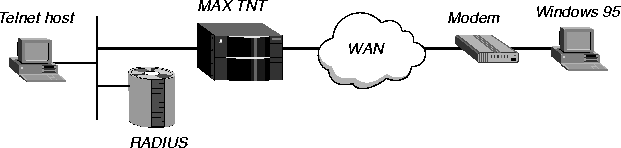
Figure 38. Terminal-server connection
If it receives an asynchronous PPP call, the terminal server does not begin a login sequence. Instead, it responds with a PPP packet, and Link Control Protocol (LCP) negotiation begins, including negotiation for Password Authentication Protocol (PAP) or Challenge Handshake Authentication Protocol (CHAP) authentication. The terminal server directs the call to the router software, and the connection proceeds as for a regular synchronous PPP session. The user bypasses the terminal server interface altogether.
In most cases, the terminal server is a stepping stone toward access to one or more network hosts. To enable host access, you can configure the terminal server in terminal mode, immediate mode, or menu mode.
See also asynchronous PPP, CHAP, Connection profile, digital modem, immediate mode, menu mode, modem, PAP, PPP, SLIP, terminal mode, user profile, V.120 TA.
A connection between a terminal and a terminal server over a LAN or WAN link. See also terminal server.
A specification that determines the number of seconds a terminal-server connection must remain idle before the MAX TNT disconnects the session. See also terminal server, terminal-server session.
An end-to-end connection between a terminal and a terminal server. Usually, the terminal-server session begins when the call goes online and ends when the call disconnects. The MAX TNT supports all the common capabilities of standard terminal servers, including Telnet, Domain Name System (DNS), login and password control, Call Detail Reporting (CDR), and authentication services. See also terminal server.
A type of .4" diameter coaxial cable for Ethernet networks. Also known as thicknet.
See Thick Ethernet.
A type of .2" diameter coaxial cable for Ethernet networks. Also known as thinnet.
See Thin Ethernet.
A feature that enables the MAX TNT to advertise Open Shortest Path First (OSPF) routes to external destinations on behalf of another gateway, commonly known as advertising a forwarding address. When third-party routing is enabled, the MAX TNT advertises the IP address of another gateway. If third-party routing is disabled, the MAX TNT advertises itself as the forwarding address to an external destination.
Depending on the exact topology of the network, other routers might be able to route packets directly to the forwarding address without involving the advertising MAX TNT, increasing the total network throughput. In this scenario, all OSPF routers must know how to route to the forwarding address.
See also OSPF.
Telecommunications Industry Association. The TIA is a group that determines standards for the electrical level of data transmission.
An IBM unit of measurement that corresponds to one-eighteenth of a second.
See TDM.
An event in which a device or user exceeded a configured time limit for responding to a device or process.
A password that appears in the LCD display of a token card. See also token card, token-card authentication, token-card server.
A hardware device, typically shaped liked a credit-card calculator, that displays a current, one-time-only password (called a token). The token grants a user access to a secure network, and changes many times per day. Token cards keep changing authentication information continuously up-to-date by maintaining a synchronized clock with a token-card server, such as a Security Dynamics ACE/Server or an Enigma Logic SafeWord server. To gain access to a secure network, each authorized user must have a token card.
A token card protects against replay attacks, in which an unauthorized user records valid authentication information exchanged between systems, and then replays it later to gain entry. Because the token is a one-time-only password, replay is impossible. See also ACE authentication, SafeWord authentication, token, token-card authentication, token-card server.
A form of authentication requiring that users change passwords many times per day. The MAX TNT supports token-card authentication by using a RADIUS server as the intermediary between the MAX TNT unit answering the call and an authentication server such as a Security Dynamics ACE/Server or an Enigma Logic SafeWord server.
Figure 39 shows a dial-in connection to the MAX TNT. The remote user must use a token card to gain access to the secure network.
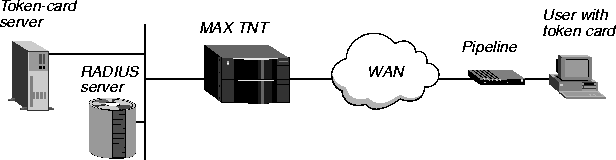
Figure 39. Token-card authentication for dial-in connections
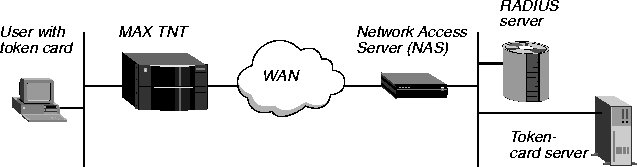
Figure 40. Token-card authentication for dial-out connections
A server that maintains a synchronized clock with hand-held token cards to provide users with a current, one-time-only password (called a token). The correct token is required to gain access to a secure network. Examples of token-card servers are the Security Dynamics ACE/Server and the Enigma Logic SafeWord server. See also ACE authentication, SafeWord authentication, token, token card, token-card authentication.
A network architecture that uses a ring topology, baseband signaling, and the token-passing media-access method. Token Ring can operate at 1, 4, or 16 Mbps, and supports four-wire twisted pair or fiber-optic media.
See TCP.
See TCP/IP.
The middle layer of the OSI Reference Model. The Transport layer provides data transfer at the proper speed, quality, and error rate, ensuring reliable delivery. Examples of Transport-layer protocols are Transmission Control Protocol (TCP) and User Datagram Protocol (UDP). See also OSI Reference Model, TCP, UDP.
A message that a Simple Network Management Protocol (SNMP) agent sends to a manager application to inform the manager of network events. See also agent, community name, manager, MIB, SNMP.
A group of switched channels to use for outgoing calls. To specify that outgoing calls use a specific bandwidth, you can configure a Connection profile or Call-Route profile to refer to a specific trunk group. You can also use trunk groups to separate lines supplied by different carriers. Each set of lines can be used as a backup if a switch becomes unavailable.
The decision to use trunk groups is a global one. Once you have enabled the use of trunk groups, every switched channel must be assigned a trunk group number or it will not be available for outgoing calls. In addition, trunk groups limit the number of channels available to multichannel calls, because only channels within the same trunk group can be aggregated.
A way of overcoming protocol restrictions on a network by encapsulating packets that use one protocol inside packets that use a protocol supported by the network.
A cable consisting of four or more copper wires twisted together in pairs. Telephone wiring is an example of twisted-pair cable. Twisted-pair cable can be shielded or unshielded. See also STP cable, UTP cable.
See 10Base-T.
A two-wire WAN link connecting the Customer Premises Equipment (CPE) to the carrier's switch. See also CPE.
User Datagram Protocol. UDP is a Transport-layer protocol that provides connectionless service without packet acknowledgment. See also Transport layer, UDP port.
A16-bit number that allows multiple processes to use User Datagram Protocol (UDP) services on the same host. A UDP address is the combination of a 32-bit IP address and the 16-bit port number. Examples of well-known UDP ports are 7 (for Echo packets), 161 (for SNMP packets), and 514 (for Syslog packets). See also UDP.
n. The electrical interface between an ISDN telephone line and a network terminator (NT1) device. See also NT1.
adj. Describes an ISDN communications device that connects directly to an ISDN telephone line. A U-interface device contains its own network terminator (NT1). See also NT1.
An ITU-T standard for sampling data by means of Pulse Coded Modulation (PCM). U-Law is most commonly used in North America and Japan. Compare with A-Law. See also PCM.
See unchannelized service.
A service that uses the entire bandwidth of a T1 PRI line (1.544 Mbps) or an E1 PRI line (2.048 Mbps). You can use an unchannelized line for a nailed-up connection, such as the link to a Frame Relay network. The MAX TNT treats the line as though it were a single connection at a fixed speed, without individual channels. See also E1 PRI line, T1 PRI line.
See unchannelized service.
User-To-Network Interface. UNI is the interface between an end user and a network endpoint (a router or a switch) on the Frame Relay network. See also UNI-DCE interface, UNI-DTE interface.
A network in which a router sends packets to one user at a time. Compare with broadcast network, multicast network.
User-To-Network Interface-Data-Circuit-terminating-Equipment Interface. In a UNI-DCE configuration, the MAX TNT operates as a Frame Relay router communicating with a Data Terminal Equipment (DTE) device. To the DTE device, the MAX TNT appears as a Frame Relay network endpoint. A UNI-DCE interface is illustrated in Figure 41.
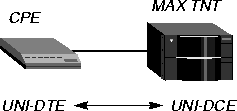
Figure 41. DCE interface connecting to DTE
User-To-Network Interface-Data-Terminal-Equipment Interface. In a UNI-DTE connection, the MAX TNT is a Data Terminal Equipment (DTE) device communicating with a Frame Relay switch (Figure 42).
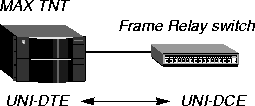
Figure 42. DTE interface connecting to DCE (a switch)
A 32-bit operating system that allows multiple users to share resources and perform multiple tasks at the same time. UNIX was developed at Bell Laboratories in 1969. Its development has occurred along two lines: the AT&T System versions and the UC Berkeley Distribution (BSD) releases. The two strains were combined by the UNIX Systems Group into System V Release 4.2 (SVR 4.2).
See DBM database.
The
/etc/hosts file on the UNIX host. The UNIX hosts file contains the names and IP address of all the hosts with which the UNIX server can communicate.A password entered in the
/etc/password file on the UNIX host. In a RADIUS user profile, setting the password to UNIX provides authentication through the normal UNIX authentication procedure. You cannot specify a UNIX password with Challenge Handshake Authentication Protocol (CHAP) authentication. See also CHAP.The
/etc/password file on the UNIX host. The UNIX password file contains passwords for standard UNIX authentication.A link that uses system-based routing, in which the entire MAX TNT system has a single IP address. If all interfaces are unnumbered, the MAX TNT operates as a purely system-based router. Compare with interface-based routing, numbered interface. See also IP routing, system-based routing.
See UTP cable.
See UDP.
The name a user must enter to access the services of the MAX TNT. See also password.
A MAX TNT profile that defines a name, password, privileges, and default displays for user login accounts.
A RADIUS users file entry that contains authentication, incoming call configuration, dialout, routing, and filter information. Each user profile consists of a series of attributes. The attributes indicate a user name and password, and enable you to configure routing, call management, and restrictions on the types of MAX TNT resources a caller can access. See also pseudo-user profile, RADIUS, RADIUS server, users file.
A RADIUS file that contains a set of user and pseudo-user profiles. A user profile enables RADIUS to authenticate a dial-in user. It consists of attributes describing the user, and the services he or she can access. A pseudo-user profile is an entry containing information that the MAX TNT can query. It does not exist for the purpose of authenticating a user. Rather, it enables you to specify static route configurations, Frame Relay profile information, and other settings.
A users file can have a flat ASCII format or a UNIX DBM database format. RADIUS must search a flat ASCII file sequentially, which might increase access time, especially if you have many users and many authentication requests. If you use the DBM database version of the users file, RADIUS can locate a record by index with only a few database accesses. However, if you reset passwords, the new passwords take effect only after you rebuild the database. If resetting expired passwords is an important component of your system, the flat ASCII file might be the better choice.
See also DBM database, flat ASCII users file, pseudo-user profile, RADIUS, RADIUS server, user profile.
See UNI.
Coordinated Universal Time. Formerly known as Greenwich Mean Time (GMT), UTC is the time at the Greenwich observatory, used as a reference point for calculating standard time values.
Unshielded Twisted Pair cable. UTP cable consists of two wires twisted two or more times per inch in order to help cancel out noise. The entire cable has no covering. UTP cable is typically used in telephone lines for voice service, ARCnet networks, 10Base-T Ethernet networks, and particular sections of Token Ring networks. See also10Base-T, ARCnet, Token Ring.
See 10Base-T.
Unshielded Twisted Pair port. The UTP port is an Ethernet port on the shelf-controller backpanel. Using the UTP port, you can connect a 10Base-T cable to the MAX TNT. See also shelf controller, UTP cable.
An ITU standard that handles initial call negotiation. With V.8bis (Voice Call Ready), a 56K modem in the MAX TNT normally sends tones at the beginning of modem training. Commonly referred to as CRe, this scheme uses a dual tone (1375Hz + 2002 Hz), followed by a single tone at 400Hz, with a combined duration of approximately 500 ms. Although V.8bis is designed not to interfere with V.32bis modem negotiation (which supports a maximum rate of 14.4 Kbps), some V.32 and V.34 modems do not successfully complete modem training after reception of the V.8bis tone.
An ITU-T standard that specifies a Physical-layer interface between Data Terminal Equipment (DTE) and Data Circuit-terminating Equipment (DCE). V.24 is nearly identical to RS-232. See also DCE, DTE, RS-232.
An ITU-T communications standard for full-duplex modem transmission of data across phone lines at rates of up to 9600 bps, with a fallback rate of 4800 bps. A V.32 modem automatically adjusts its transmission speed based on the quality of the line. Compare with V.34.
An ITU-T communications standard for full-duplex modem transmission of data across phone lines at rates of up to 28,800 bps. A V.34 modem automatically adjusts its transmission speed based on the quality of the line. Compare with V.32.
An extension of the V.34 standard, allowing data rates of up to 33,600 bps. See also V.34.
An ITU-T standard for high-speed synchronous data transmission and exchange. In the U.S., most routers and Data Service Units (DSUs) that connect to T1 lines use V.35. See also DSU, router, synchronous transmission, T1 line.
An ITU-T error-detection standard for high-speed modems over digital telephone lines. The V.42 standard makes use of the Link Access Procedure, Modem (LAPM). See also LAPM.
A standard for encapsulating asynchronous data communication into synchronous ISDN data. Using standard, asynchronous-only COM ports and a V.120 adapter, two computers can communicate over an ISDN connection. The V.120 adaptor can be connected externally or internally.
V.120 Terminal Adapter. A V.120 TA is an asynchronous device that changes the format of asynchronous data to match the specifications of the V.120 standard for data transmission over an ISDN line. A V.120 TA is also known as an ISDN modem. See also TA, V.120.
See VJ compression.
See VLSM.
The use of a digital video-transmission system to communicate by means of video and voice. A digital video-transmission system typically consists of a camera, codec, network-access equipment, network, and audio system.
A network required for the MAX TNT to route AppleTalk to dial-in clients. You define a virtual AppleTalk network by defining a unique network range. See also AppleTalk routing, network range.
A network required for the MAX TNT to route IPX to dial-in clients. When a NetWare client dials in, the MAX TNT negotiates a routing session by assigning the client a network address on the virtual IPX network. The client must accept the network number that the MAX TNT assigns. If the client has its own node number, the MAX TNT uses that number to form the full network:node address. If the client does not have a node number, the MAX TNT assigns it a unique node address on the virtual network. See also IPX network.
See VPN.
Van Jacobson compression. VJ compression is a method for compressing Transmission Control Protocol (TCP) headers in order to decrease round-trip times on Serial Line Internet Protocol (SLIP) connections. The version of SLIP implementing VJ compression is called Compressed Serial Line Internet Protocol (CSLIP). See also compression, CSLIP, SLIP.
Variable-Length Subnet Mask. A VLSM is a way to configure an IP subnet for maximum flexibility. Two different subnets of the same IP network number may have different masks and, therefore, different sizes. A packet is routed to the longest or most specific match. VLSM is also referred to as Classless Inter-Domain Routing (CIDR). See also IP subnet, subnet mask.
Virtual Private Network. A VPN is a private network that uses the Internet to carry all traffic. It can link all the offices, telecommuters, travelling employees, customers, and suppliers for a single organization. A VPN is virtual because it appears to the organization as a private network. Each user sees only his or her own traffic. See also private network.
An ASCII-character data terminal, consisting of a screen and keyboard. Manufactured by Digital Equipment Corporation (DEC), the VT-100 has become an industry standard data terminal. VT-100 emulation software allows a standard PC to act as a VT-100 terminal. See also terminal emulator.
Wide Area Network. A WAN is an internet of devices, generally consisting of several networks distributed over a wide geographic distance, connected by telephone lines, and using different hardware platforms and protocol encapsulation. See also internet.
A connection between two endpoints over a WAN, as opposed to a local connection by a serial or Ethernet link. See also WAN.
See WAN.
See WINS.
Windows Internet Name Service. WINS is a Microsoft product that manages the mapping between resource names and IP addresses. The Domain Name System (DNS) service used on the Internet cannot dynamically map IP addresses to local resource names. Through dynamic database updates, WINS lets a user gain access to network resources by means of user-friendly names, rather than by means of IP addresses.
See hub.
A MAX TNT profile loaded into the edit buffer by means of the Read command. Only the working profile can be modified. See also profile.
A set of connector, electrical, and dialing specifications for the synchronous interface between Data Terminal Equipment (DTE) and Data Circuit-terminating Equipment (DCE) on a digital network. See also DCE, DTE.
See RAI.
An AppleTalk entity that enables you to organize the services available on your network. See also default zone, zone list.
A list of up to 32 AppleTalk zone names for the local network. Each name consists of up to 32 characters, including embedded spaces. The characters must be in the standard printing character set, and must not include an asterisk (*). See also default zone, zone.
Copyright © 1998, Ascend Communications, Inc. All rights reserved.